Saturday, October 25, 2014

Maybe a little bit more advice on the job letter

I've written a bunch of posts full of advice about the job letter, and I don't want to repeat myself so this will be short.

As far as I can tell, the advice has not changed from blog to blog or year to year, but there are a couple of points in otherwise good posts that I would like to challenge.

1. Karen Kelsky (Professor is In) usually has good advice, like about tailoring a job letter. (Of course I think it's good; it's advice I've given myself. ) I did read somewhere that it's too much of a burden for the applicant to tailor a job letter, but if you're applying for a job you are serious about, what do you think?

 But she thinks Interfolio and non-tailored letters from your faculty recommenders are a sign of the apocalypse, or anyway serious professional laziness on the part of faculty.  I'm happy to write personalized letters, but as a member and/or chair of a search committee, I certainly didn't expect personalized letters from faculty members that had tailored them to our specific hiring needs.

2. Philip N. Howard's helpful Inside Higher Ed essay on the lines needed in job letters has a lot of good advice, too. Amidst this excellent advice, though, is one thing that might not be true:
"Address your letter to the person heading the search or the department head. A greeting such as 'Dear Committee Members' shows you haven’t done enough research." 
"Research" in this case may involve defying the HR requirements of posting the ad, which for various reasons may not list a name at all but may instead  specify that the letter has to be addressed to "Search Committee Chair" or some such. I don't know why they do this, and I'm not brave enough to go to HR and find out.

So "research" in this case may involve using the name of the department chair, or calling the department and requesting the name of the search committee chair. I get why Howard would think this is important, but what if 300 applicants all call the administrative assistant to try to get this information in the name of "research"?  It's nice if you have the name, but don't lose any sleep over it if you don't. It's a salutation, not the Holy Grail.

Let me assure job candidates who may be reading this that, as a search committee member and/or chair, I could not tell you whether the hundreds of letters I read had my name, the department chair's name, "Dear Committee Members," or "Dear Bozos on the Bus." Quite honestly, we skip to the first paragraph -- AS WE SHOULD-- and get right to the substance of your qualifications and interest in the position.

3. The letterhead issue is another one that bloggers, CHE, and IHE have written about for the past ten years or so. Karen Kelsky points out that you should be able to get an electronic version, or, in a pinch, Photoshop a version of it for your electronic publications.  I'd only add that your department probably has this for the asking for grad students (although some don't give it out).

 In a funny reversal, when I asked for this letterhead template a few years ago, various Northern Clime admins assured me that we had no such thing for faculty or students. What was I talking about! Didn't exist! A student did have a copy of it, though, so that's how I was able to post much better-looking versions of letters to job portals and Interfolio. For the most recent logo redesign, we were officially sent the template, which is a step in the right direction.

Monday, October 20, 2014

Pedantry or self-preservation?

It's grading season--wait, it's always grading season, isn't it?--and as the papers come flooding in, it's inevitable that we'll get some of these:
--papers with no page numbers
--electronic papers called things like "myroughdraft.doc" or the ever-popular "paper1.doc."
--papers with no Works Cited
--papers with no names
--papers with Works Cited in a separate file
--papers in some odd format that can't be opened
--Works Cited in some peculiar numbered list, which we don't use in MLA

Now, on the papers themselves, we're used to explaining, or not explaining if you believe in minimal marking, when there's a comma splice or a fragment or a missing apostrophe. I am sometimes told I'm the first person ever to point these out to the student, which, if true, is kind of sad and inspiring at the same time (as in they're better off to learn about it now).  Along with commenting on the contents, which is the more important part, it's part of our jobs to note these.  We grade holistically, so we're not dinging them for points all the time.

But those format things in the list above used to make me bang my head on the desk.  Why would they not follow the guidelines that I'd given to them? I'm writing a final comment, and I have to number the pages myself to say "On p. 4"--why, oh why, is it up to me?

[Edited to add, in light of Tenured Radical's recent column: I don't make fun of them for this, or think they are doing it to spite me, or think it reflects on them as people in any way.  Anyone who's ever filled out a grant application or any other kind of form can testify that when you're trying to get it done, you'll always find some piece that you find arbitrary. That puts you and the students on the same level ground about requirements.

No, my issue is strictly whether it makes more work for me or not.]

Then I got smart.  The papers are still graded holistically, but here's a test: does it make more work for me if Stu Dent didn't complete the format things? Then Stu Dent gets a gentle reminder on the first paper, and after that, it's -1 for those things. It's not enough of a penalty to hurt them, but it's enough to get their attention--and it seems to work.

Some would call it pedantry.  I call it the "you make me work to do something you were supposed to do, you pay" rule, or self-preservation.

Sunday, October 19, 2014

Test post

The Mac OS updated itself today, and in addition to making all the icons look like international traffic signs, it's messing with things like Firefox and Chrome.

I log in, but it says I'm not logged in when I try to comment on other blogs, sort of like this duet from Annie Get Your Gun. Watch it if you are brave and can watch Betty Hutton without screaming.

"No, you can't."

"Yes, I can."

"No, you can't."

And so on.


Friday, October 17, 2014

Writers on Writing: Winston Churchill

I want to reply to Historiann's challenge, but first a post about writing.

From The Guardian, a window into Winston Churchill's methods of writing, with comments:
Downstairs there is a room with green lamps hanging from the ceiling, and maps on the wall, and a telephone exchange: and here Churchill kept his researchers – about six of them at once, junior Oxford dons, research fellows, some of them destined for high academic honours. There they were, filleting, devilling, rootling around in books and documents in search of stuff that might be of use.
Comment: Would you want this?  It's the Doris Kearns Goodwin way of writing (teams of researchers finding material that you fashion into text) and it works well for her and others.  But would you have as good a sense of the primary texts if you had outsourced, so to speak, the initial reading of them? 

I'd like to try a research assistant, since I'm sure it would help. If nothing else, I could set a research assistant to changing all the @#$%^& in-text citations to endnotes in Chicago 16 style.  (I have experimented with Endnote's Chicago 16 setting & don't see any way to do this automatically.)

After dictating to a squadron of scribes all night, Churchill would have text. Oh, boy, would he have text--more, Boris Johnson, the author, tells us than Dickens and Shakespeare combined:
The sheaves of typewritten paper he would then correct and amend by hand – and we have innumerable examples of his cursive blue-inked marginalia – and the results would be typeset as they would appear on the page; and even that was not the end.
He would fiddle with the text. He would switch clauses around for emphasis, he would swap one epithet for another and, in general, he would take the utmost delight in the process of polishing his efforts; and then he would send the whole lot off to be typeset again.
Why did he write? Partly for money, but also for this:
His creative-depressive personality meant that writing (or painting, or bricklaying) was a way of keeping the “black dog” of depression at bay. He wrote for that sensation of release that comes with laying 200 bricks and writing 2,000 words a day.

Monday, October 13, 2014

The End Matter

I'm close enough to the end, or I'm deluding myself I'm close enough to the end, of this manuscript to start compiling the Works Cited in an actual document rather than Endnote as I work through the footnotes. In looking at the press's guidelines today, guess what citation format I'm supposed to use.

MLA? No.

Chicago 14? No.

Chicago 15? No.

APA? Bite your tongue.

Chicago 16?  Yes indeed, the only one that I had not, until today, shelled out $42 to purchase. Now, if I ever leave academe, I will have enough hefty Chicago/MLA Style books to serve as doorstops for every door in the house.

This made me think of one of my favorite essays, whose title I've shamelessly stolen, Louis Menand's "The End Matter."  Among other gems, there's this one:
To begin with, the designers of Word apparently believe that the conventional method of endnote numbering is with lowercase Roman numerals—i, ii, iii, etc. When was the last time you read anything that adhered to this style? It would lead to sentences like:
In the Gramscian paradigm, the “intellectual”lxxxvii is, by definition, always already a liminal status.lxxxviii
If I weren't laughing so hard, I would cry, because every single time I rename or resave a file, my footnotes revert from Arabic numerals to the Word default for endnotes, something that looks like ASCII run amok.

And I have been looking into the mysteries of compiling master documents in Word, of which only two pieces of advice found online are remarkably consistent:

1) If compiled improperly, master document can turn your chapters into word salad.
2) Sometimes it turns your chapters into word salad just for the sheer joy of destruction.

I still have a lot to do, conference papers to write, and so on, but the fact that I'm getting this close to the end matter makes me think that this will not be the Key to All Mythologies but an actual book.

And now, for a treat, I'm going to read "The End Matter" one more time.

Monday, October 06, 2014

Clap your hands if you believe

I'm not writing here much lately because, in looking at CHE and IHE and ChronicleVitae, I feel as though I've seen these issues before, some of them a lot of times, and written about many of them (ditto).

But one that I'd like to see more specific data about is a trend whereby the PhD and inventive variants are promoted as good bets for working in various unnamed industries or libraries. Aren't librarians having trouble finding work? What kinds of industries? What kinds of foundation work?  The articles I've seen tout 3 or so success stories as the wave of the future, but what are the facts?

Sometimes the Ph.D. is promoted as an enrichment degree so valuable even if you don't get a job, you'll be glad you spent 10 years doing it, which might be true if you are independently wealthy or retired.

Sometimes they even propose expanding or creating new degrees that don't have the expectation of university teaching at the end of it, as in the recent kerfuffle at Cornell.  The descriptions of what exactly graduates would do are both uplifting and stunningly vague, as though even those proposing the degree don't have much of a concept beyond mad critical thinking and research skilz--good in themselves, but how about specifics?

Sometimes, it's not only an enrichment but something you owe it to the world to treat as a calling:
To sustain scholarly inquiry, we need scholars around the country and world engaged in research and capable of critically assessing each other’s work. We need to ensure that humanities graduates at all levels — in K-12 schools, museums, local societies, media, universities, and government — have the space and time to engage in scholarship and be part of the conversation.
Well, yes. Yes, we do need scholars.  Let me add the important corollary that scholars need to eat, and have health insurance, and maybe a place to live and a car to drive, even if you're not counting expensive, frivolous extras like having children.

The article goes on to say we need to address supply and demand:
On the demand side, we must expand the number of tenure-line positions in the humanities across the nation and resist the deprofessionalization of teachers and professors.
Well, done and done, then!

I should not be so cynical about this, but it is crazymaking to read something like this--"we must expand"--when none of this, none, zip, nada is in the power of ordinary academics to do.  We can try, but we do not control the money. Let me repeat: We do not control the money. We have little say over how it is spent, how salaries or research funds are allocated, and did I mention having no control whatever over allocations from the state or Board of Regents or whoever determines the university's budget?  For most of us, simply retaining a line when someone retires instead of having it snatched back by central administration is cause for feasting and dancing around a sacred idol.

When I was little and saw Peter Pan, there was a scene where Tinkerbell was dying and we all had to clap our hands and believe if we wanted to make her well.  Without more facts, these articles seem to me to be saying "clap your hands if you believe, and you will make it so."  I wish these confident assertions were true, but I want some investigative reporting rather than opinion pieces to tell me how they might be.

Saturday, September 27, 2014

Dear Ms. Undine answers self-evident questions

Dear Ms. Undine,

Ms. Mentor calls October "exploding head month" because of all the grant applications due then.  A whole lot of local ones are due next week. How can I deal with applications that want to know how much money I need to spend on June 10, 2015 when I can barely get through the stuff I need to do for next Tuesday?

Signed, Future Shock

Dear Future,
Here are some possibilities:
1. Start last year.
2. Start tomorrow for next year.
3. Seriously, practice a little time management.
4. Comfort yourself in the knowledge that with grant support so tight (NEH funds 6% of its individual scholar grants) you are likely only to be bragging fodder for its glossy brochures anyway: "We got 10 zillion applications and only funded 5! Look how selective we are! Yay for us!"

Dear Ms. Undine,

Clay Shirky, a famous person on the Internet, has pronounced laptops a distraction in the classroom and restricted their use, something I figured out and did a long time ago.  Now the fanboys who have called me a Luddite and blamed me for not liking the Shiny Things are falling all over themselves pronouncing the Wisdom of Clay.  Why is this so?

Signed,

Not Ned Ludd

Dear Not Ned,

Because you are not famous on the Internet, and because, I fear, you are not a guy and hence to fanboys do not have the mental equipment to think intelligently about Shiny Things. Think of yourself as the secret Queen of the Internet who predicts all things but whose power would be diminished if anyone listened to you.  In other words, get over it.

Dear Ms. Undine,

Out of idle curiosity, I looked at the MLA Job List and discovered that there are only 5 jobs in the country, 3 in something resembling my specialty, at the associate or full level!

Signed,

This is a job market?

Dear This,

Unless you have spent the last 30 years in silent meditation and prayer, surely this cannot be a surprise to you.  Ms. Mentor had a column about this recently, which if the CHE had a search feature instead of a Ouija Board, I would seek out and link to.  Surely you can find better things to do with your idle curiosity, like putting your books in some kind of order, or writing something, or taking a walk around the block, or, better still, helping your students and junior colleagues to get prepared for their job applications. 

Wednesday, September 17, 2014

Was there ever a time of idealism in college?

Dean Dad has an interesting post about artists and the advice being given to them:
-->
But where some variation of “follow your dreams” would have gone when I was in college, I heard “learn a trade” and “get good at living on very little money.”
He continues:
What I didn’t see, though, was youthful idealism.  I didn’t see what I used to think of as teenage bravado.  I saw some very young people who had been forced by circumstance to act in ways that used to be the province of their elders.  I saw young adults, rather than teenagers. 
In many ways, that’s great.  Given the very real economic obstacles many young students face, a certain gritty realism is appropriate.  And if memory serves, teenage bravado can be wearing in its own right.
But that “bulletproof” teenage stage -- that, in retrospect, relies on a base of economic security -- serves a purpose.
Dean Dad's take on this is interesting, for he sees it as a generational issue, whereas I see it as a class issue.

Although I went to college in a time that was supposed to be somewhat idealistic, the people I knew at public universities never went through a "bulletproof" stage of economic security where they thought "follow your dreams" was good advice. Idealism costs money, either immediately or in the future, and they knew it.

That's not to say that people weren't idealistic, or that they didn't do the same stupid things that college students have always done, but they understood the "gritty realism" of the consequences. The idea that you could throw yourself on the economy like a trampoline and bounce back wasn't part of the equation.

Private universities or elite publics--sure.  My friends who came from upper-middle-class professional backgrounds knew they could do whatever they wanted. If they made money in the summer working for their parents' friends, it went toward backpacking in Europe and not toward next year's expenses.  It's not that one was wrong and the other right, but they were different experiences.

I've been thinking about this because of reading other Mid-Century Males, Jack Kerouac and other Beats in particular.  Kerouac didn't want to be tied down, which may be the understatement of the decade, but whenever he got the urge to travel, which was most of the time, he had two things going for him: (1) plentiful manufacturing or service jobs that he could get easily and then leave and (2) like Allen Ginsberg, a family that, though not wealthy, would scrape up the money for bail for him when he got in trouble with the law.

The same seems to be true for the following decade, the 1960s, as I mentioned in a post about a year ago in talking about Sara Davidson's Loose Change:
What I actually took away was that people in those days could quit, drop out, or do any damn thing they felt like doing, and there would be someone or something to pick them up afterwards: plentiful jobs, more jobs than there were applicants, seemingly;  a network that would allow the main character, with just a phone call from one of her parents, to go to Europe and work as a translator in Italy; and a generous system of social service benefits that wouldn't let them fall into poverty.  They could change the world--or at least the upper-middle-class white women in the book could--because the world was going to support them financially no matter what they did.  I realize that that's probably not true, but it has a truthiness to it and seems true, given what Davidson describes.
  I think Dean Dad is right, but only partially so.  The idealism gap, if you can call it that, was always there for some students, but now it's hitting the class that used to be told "follow your bliss," and that's what speaks to the troubling reality that he's talking about.

Friday, September 12, 2014

Solving for X, where X = time to write

It's that time in the semester when it's late enough to see how the trajectory of meetings, classes, admin, etc., is going to go but early enough to correct the course. What's vanished, as usual, are the two things that matter most: time to get out and exercise, and time to write.

The usual distractions are under control, I think.  I stopped checking email on weekends, and the sky hasn't fallen, although I did miss out on a couple of opportunities by ignoring email until Sunday night.  I've blocked Facebook during work hours, even during department meetings, and my Twitter presence has dwindled to about nothing.

 No, this is about other variables: the carefully planned day of meetings that, when one of them gets shifted, means another full day on campus and no writing or exercise. That's a variable I can't control.

Another variable I can't control is administrative deadlines. These aren't a problem in themselves, but they require big blocks of time to do the tasks. Imagine if you had 1,000 widgets to put into a complex set of boxes but got called away in the middle.  You'd have to restart the process, so these tasks can't be done in 15-minute blocks with interruptions.

A variable I can control is clock time--getting up earlier, for example, as many people advise. But since I don't always sleep well, getting up at 4 or 5 a.m. to write can lead to sleepiness when driving.  I can't control fatigue, either, after a day on campus.

I did try the 10-15 minute "write when you have time" method the other day and was nearly late for a meeting, since I got absorbed in the task at hand.  The research journal I started a couple of years ago has been the best way to keep engaged with the writing, though.

In short, I'm still solving for X, but I think the answer may lie in (1) regular writing in my research journal; (2) ignoring email as much as possible; and (3) getting some more sleep.  (3) may not be immediately achievable, but (1) and (2) certainly are.

Any suggestions?

Wednesday, September 10, 2014

Roundup: Now with writing inspiration

*Poofed* part of this because it was entirely too cranky, even for me.
  • Historiann's lovely writing space, which inspired me to clean both my office and my home desk.
  • "Less is More" in writing by GetALifePhD (Tanya Golash-Boza) has some writing inspiration. 
  • Inspired by Flavia Fescue's posts about writing in journals,  I downloaded Day One, a journal app. It tries desperately to post whatever I write to Facebook and Twitter and is hell bent on getting me to put in information so that it can report to our Alien Overlords of Social Media.  I haven't given it any information, but I don't trust it. Isn't a journal supposed to be private, or is exposing your private thoughts to the known world the new function of a journal?
  • Karen Kelsky says it's a mistake for job applicants to use a dossier service. Having been on many, many search committees as chair and as just a member, I don't agree.  The key thing is going to be the candidate's letter, CV, writing, and general tenor of the letters.  I can and do write those job letters for my students on the market, although it takes time, but is there really an Interfolio disadvantage? Readers, what say you? 
  • Speaking of writing recommendation letters, if you have not yet read Julie Schumacher's Dear Committee Members, do it. Your local library probably has it, it's a quick read, and it's both hilarious and uncomfortably close to the truth about how many of these letters we have to write for everything and the place of humanities in the university pecking order. 
  • John Oliver takes on student debt: https://www.youtube.com/watch?v=P8pjd1QEA0c

Friday, August 29, 2014

Don't email me? Welcome to my bunker, and pull up a chair

This article at Slate (originally from IHE)  describes the experience of a professor at Salem State who banned student emails.

The good news is that more students came to her office as a result and her evals went up, so I guess if it works for you, you ought to keep doing it.

But are professors really "assaulted" by email?  That's a pretty strong verb.
Duvall’s frustration is shared by many in academe -- or anyone with an email account -- from faculty members beset by questions they have answered both in class and in writing to students inundated by university email blasts. This spring, when Duvall taught at the University of South Carolina at Aiken, she adopted a new email policy to cut down on emails from students telling her they would be late, or would miss class, or would have leave early, or any of the countless others that could be handled face-to-face.
Instead of wasting class time on walking her students through an increasingly complicated flowchart diagram of when they could and could not email her, Duvall stopped the problem at its core: No emails -- unless you’re scheduling an in-person meeting
A flowchart for email, really?

I know that professors complain (in blogs, at CHE) about massive numbers of emails from students, but since we're dealing with a "my experience is data" topic anyway, I haven't experienced this. Students have usually been respectful and not asked pointless questions, unless my memory has erased those emails.

Wouldn't you rather have an email than have the student show up at your office, sneezing and coughing and shedding used Kleenex into your wastebasket,  to tell you she's not going to be in class? Or am I the only recipient of these "see, I am really, really sick and not lying" visits?

Don't you think if a student emails you to say she'll be late or absent that it shows some attempt to be engaged with the class or respectful of your expectations that she'd be there?  Yes, it's better if they stop after class to tell you that they'll be absent, and most of them do that anyway.

If there's some special circumstance or absence, like a sports team event, wouldn't you rather have it in an email where you can document it instead of relying on your memory?

I'm all for more in-person interaction with students, but this would, for me, be a sealing wax policy too far.  What do you all think?


Thursday, August 28, 2014

Dear Ms. Undine dispenses more wisdom

Dear Ms. Undine,

In between admin, prepping classes, meeting, and still trying to keep some time for writing, I take out a few minutes to read higher education sites for distraction, which are filled with stuff I already know--teaching tips, how to handle email, and the like as though it is a fresh, new thing. I could have written them myself. This annoys me, because it violates my prime directive of not wasting my time. What should I do? 

Signed, Been there, done that

Dear Been there,
You know the answer to this one: you are looking for distraction in all the wrong places, and you, not they, are wasting your time.  

Those sites are for people who are just starting out, and to them, those things are exciting and new.  You know how kittens and puppies get intrigued by things that your cat or dog now ignore, and how nice you think it is that they are excited by them?  This information is valuable, just not to you. Be happy that people find them valuable, and stop reading them, or you'll be saying, "hey, kids, get off my lawn" at the next faculty meeting.  Oh, and pick up a book instead.

Dear Ms. Undine,

I noticed that you wrote about your lengthy syllabus with lots of policies, and there is a recent Slate article about the same thing. I have two questions. First, how did two people decide to write about this at the same time?  Second, do you agree with the article about just writing tl;dr and protesting the syllabus?

Signed,  Mysteries of the universe

Dear Mysteries,

There are only two explanations  for your first question: either (1) I have massive powers of telepathy and the ability to make the universe bend to my will by echoing my thoughts or (2) it's the beginning of the semester and everyone is making up a syllabus. Obviously the first is the rational explanation. 

About your second question: No, I don't agree that the long syllabus is the decline of academia as we know it.  When you explain the syllabus, you can emphasize certain parts, but if it's all there, they can read (or, okay, ignore) it on their own. They are not going to follow a link, and everyone knows it, so that's a non-starter. My only regret is the absence of sealing wax

Dear Ms. Undine,

I had a conversation today in which someone observed that her male teachers were more apt to share information about themselves when introducing themselves to the class than her female teachers.  Do you think this is true?

Signed, Gender difference or coincidence?

Dear Gender,

I don't know, but I'm curious about this.  Readers, what do you do when you introduce yourselves, or what do you think? 

Tuesday, August 26, 2014

First day impressions

  • I hope they're going to like the class. I worked hard on the syllabus and readings.
  • I don't do much more the first day than explain the syllabus and introduce some of the assignments, since there's a lot to cover.  
  • If your university is like mine, it now has lots of policies, goals, and so on in specific boilerplate language that has to go into the syllabus. The syllabus now resembles Henry VIII's divorce petition to the Pope with all the wax seals. 
  • I wish I could add an interesting wax seal for each of the policies.
  • I wish we could have a day of experimenting with sealing wax without giving the fire marshal a heart attack.
  • It was nice to see colleagues when they are (and I am) relatively rested after the summer, even if we all worked all summer. 
  • It felt strange to be on campus instead of out for a walk/run early in the morning, looking at the deer in the fields and speculating about which little buildings behind people's houses might be writing houses.

Tuesday, August 19, 2014

Through a glass eye, darkly: listening to the Alternavoice

Flavia has good a post up about a book that she read and that, quoting Dorothy Parker, she says she wants to hurl with great force out of her house.  It's a book about a guy having a mushy, lukewarm crisis of faith. She also says that she doesn't necessarily finish books any more once she's given them a fair (100 pages, more than fair) chance.

Finishing books? Not necessarily, any more.  I recently tried a modern classic, but after reading the preface about how it would be challenging, frustrating, and confusing, even a little boring with all the digressions, but that the 1000+ pages would be totally worth the effort, I let the Kindle app quietly return it to the library without forging ahead.  Maybe I'll try again in twenty or thirty years. If I'm going to work that hard, I'd rather work, if you see what I mean.

No, the thing that worries me a little is that in rereading some classics, including my recent stretch of visiting the mid-century males, my first reaction is often no longer "This is a Timeless Classic with Enduring Themes and Universal Truths," the gospel I was taught, but "Oh, great--more twentysomething guy problems."  As Mark Twain once said of James Fenimore Cooper in a very different but totally hilarious context, I'm seeing through a glass eye, darkly.

I can't tell whether this is a gender issue or an age one, since I've read so many more novels since first encountering those classics. I can still appreciate all the formal stuff and even a little stylistic fancy footwork, but in the big Crisis of Faith moments, a still, small voice in the back of my head is saying something like "Dude. You are worrying about this, really? Get a grip."

The Alternavoice hasn't always been there when I read. I think reading all the junk on the web has cultivated it, from listicles to the faux questions at Slate and HuffPo and now all the news sites.  It's not there with everything I read, which is a good thing.

And the Alternavoice isn't all bad.  It slips out in class sometimes, in some almost-snark pointing out problems in a text. I don't want to go all trollish on a piece of writing, of course, but it's good for the students to see that what we're reading isn't holy writ and that there's another way to look at the hero's dilemma.

Maybe I need to write up an assignment where they can let their Alternavoices loose, but once it's out of the cage, as evidenced in my brain in the last year or so, it's out for good.

Do you have this voice when you read literature? Is there some situation or plotline that especially brings it out?

Wednesday, August 13, 2014

Dear Ms. Undine answers more questions

Dear Ms. Undine,
From Shutterstock

Someone just wrote a book that is entirely composed of tweets about writing a book. People post about how they are writing (#amwriting) and how good they feel about it. The author says that it's not cruel to make fun of these people. The book sells for $9 on Amazon.

If I cite this using MLA, do I put it as an edited book? Did I miss the boat on collecting other people's words for free and charging for them? Is it possible that making fun of random strangers who post on Twitter could be considered cruel?

Signed, Soft-hearted Susan

Dear Susan,

Yes.

---

Dear Ms. Undine,

I want my class to be a success on the first day. Do you have any advice?

Signed,  Newbie

Dear Newbie,

You can find a good list at Vanderbilt or your own university's teaching and learning center.  That list is mostly great advice, although I don't follow this part under the "sharing information" section: "Personal biography: your place of birth, family history, educational history, hobbies, sport and recreational interests, how long you have been at the university, and what your plans are for the future."

I figure if they know that I'm a humanoid life form and where my office is, that will about exhaust their interest in me.  If they want to know more, they will ask.

---

Dear Ms. Undine,

I would like to save paper by not printing a syllabus but by putting it in Blackboard/Canvas instead. Students will read it there before they come to class, right?

Signed, Dances with Trees

Dear Dances,

Long ago, in a classroom far away, a dewy-eyed Ms. Undine believed as you do.  Then she checked the usage statistics to see how many students had looked at the syllabus and emerged a broken woman.

You don't have to hand out print copies of everything, but a print copy of a syllabus is like a contract for the class.  Just the physical act of handing out something on paper will help them to take it more seriously.  They are online all the time, and what's there is ephemeral to them. Since a piece of paper is no longer the norm, it has more weight than a bunch of pixels.


Tuesday, August 12, 2014

At NY Review of Books: The Hi-Tech Mess of Higher Ed

As a distraction from the national news, here are snippets of a review of the film The Ivory Tower  from the NY Review of Books, starring our old friend the MOOC. Below are the usual claims and the reality.

1. MOOCs will free up professors from the drudgery of lectures through the flipped classroom model and will allow them to "teach" through hands-on help with students. Professors will not become glorified teaching assistants or handmaidens to greatness. because that's just stupid fear-mongering on the part of thuggish teachers' unions. It won't happen because trust us, it won't, universities being unlike any other business in that they will provide free services for the public good once they can't charge for them.
A conventional delivery system for “the personal touch” in the MOOC format is the so-called “flipped classroom.” Here a teaching assistant circulates in a roomful of students who have watched the assigned video, and helps them to sort out questions about details. The assistant—as Ivory Tower suggests with a single understated caption—will often turn out to be somebody who was once a professor but whom economies facilitated by MOOCs have demoted to the status of section leader.
2.  Students will learn better and more efficiently in a MOOC.
 In 2013, the company [Udacity] was awarded a trial of its offerings in a contract with San Jose State University; and in July of that year, scores were posted for its spring term entry-level courses. The pass rate in elementary statistics was 50.5 percent; in college algebra, 25.4 percent; in entry-level math, 23.8 percent. Teachers have been fired en masse for results like these by administrators or politicians who would not sit for an explanation.
3.  A rock star teacher in a MOOC makes a world of difference and will do a much better job than, well, 500 ordinary teachers.
What you really want, [a Udacity adept] thinks, is the academic equivalent of a “rock star” to project knowledge onto the screens and into the brains of students without the impediment of fellow students or a teacher’s intrusive presence in the room. “Maybe,” he adds, “that rock star could do a little bit better job” than the nameless small-time academics whose fame and luster the video lecturer will rightly displace.
Note that there's no proof here, because why do you need proof when you have one anonymous stockholder's or employee's opinions? We all know that people learn from celebrities.  Maybe Kim Kardashian could teach a class.

4. MOOCs have always been about the greater good of reaching thousands with free learning. That's why university administrators, a notably starry-eyed bunch unconcerned with the bottom line, are so keen to implement them.
Still, however fanciful the conceit may be, the MOOC movement has a clear economic motive. Many universities today want to cut back drastically on the payment of classroom teachers. It is important therefore to convince us that teachers have never been the focus of real learning.

Monday, August 11, 2014

Don't multitask; partition your day. Your brain demands it.

No post today, but "Hit the Reset Button in Your Brain" at the New York Times describes what the brain struggles with when interrupted. Read the whole thing; it's worth it.
Every status update you read on Facebook, every tweet or text message you get from a friend, is competing for resources in your brain with important things like whether to put your savings in stocks or bonds, where you left your passport or how best to reconcile with a close friend you just had an argument with.

If you want to be more productive and creative, and to have more energy, the science dictates that you should partition your day into project periods. Your social networking should be done during a designated time, not as constant interruptions to your day.
 Email, too, should be done at designated times. An email that you know is sitting there, unread, may sap attentional resources as your brain keeps thinking about it, distracting you from what you’re doing. What might be in it? Who’s it from? Is it good news or bad news? It’s better to leave your email program off than to hear that constant ping and know that you’re ignoring messages.
And this from the Wall Street Journal
“People can’t multitask very well, and when people say they can, they’re deluding themselves,” said MIT neuroscientist Earl Miller. “The brain is very good at deluding itself.” Simply put, we can’t focus on more than one thing at a time. What we do is shift focus, trying to manage multiple threads. “Switching from task to task, you think you’re actually paying attention to everything around you at the same time. But you’re actually not” said Miller. Researchers like Miller say they can actually see the brain struggling. “You cannot focus on one while doing the other. That’s because of what’s called interference between the two tasks” explains Miller. “They both involve communicating via speech or the written word, and so there’s a lot of conflict between the two of them. 
The challenge is to define the problem – and the solution. “The current system lets other people add things to my to-do list” says Esther [Dyson]. 

Friday, August 08, 2014

Writing house fantasies: a picture

Over at the New York Times, "Plot Thickens as 900 Writers Battle Amazon" informs us about the Hachette Publishing/Amazon struggle.

I know that this is an important controversy, but what the NY Times published and what I read were two different things.
What it says:
ROUND POND, Me. — Out here in the woods, at the end of not one but two dirt roads, in a shack equipped with a picture of the Dalai Lama, a high-speed data line and a copy of Thoreau’s “Civil Disobedience,” Amazon’s dream of dominating the publishing world has run into some trouble.
Douglas Preston, who summers in this coastal hamlet, is a best-selling writer — or was, until Amazon decided to discourage readers from buying books from his publisher, Hachette, as a way of pressuring it into giving Amazon a better deal on e-books. So he wrote an open letter to his readers asking them to contact Jeff Bezos, Amazon’s chief executive, demanding that Amazon stop using writers as hostages in its negotiations.
 What I read:
Blah blah blah blah WRITING HOUSE PICTURE.

Wednesday, July 30, 2014

Dear Ms. Undine answers some more of your academic questions

Dear Ms. Undine,

IHE recently reported that colleges in Michigan are outsourcing their hiring of adjuncts to something called EDUStaff.  The colleges are delighted because they can chisel even more money from adjuncts stop retirement contributions to faculty and, in one case, "ending retirement contributions saved the college at least $250,000 in the first year." I'm guessing the money went toward a climbing wall, more luxuries for the football team, and a new no-books atrium for the library, but I'm concerned that individual schools won't get to know the people who are teaching their students.  Am I right to be concerned?

Signed, Miffed in Michigan

Dear Miffed,

Yes.


Dear Ms. Undine,

Recent essays on being published and on mistakes humanities scholars make in trying to be published  seem to say that publication is a possibility and that, in fact, "if you're not a writer, you're not a player." Being a player makes me feel like Frank Sinatra at the Sands circa 1960.  Do I have to be a player to be a writer?

Signed, Ring-a-ding-ding

Dear Ring,

Not unless you have Sammy and Dean and Angie Dickinson on speed dial.


Dear Ms. Undine,

I want to submit an article, but I am now terrified of the "mean girls" who constitute a totally vicious academic universe. I'm picturing Laurence Olivier in Marathon Man, but meaner. Is it true that peer reviewers live to inflict pain?

Signed, Anesthesia

Dear Anesthesia,

No. Although there are exceptions, they live to carve time out of their own writing time in order to provide what they hope is helpful feedback to improve someone's article.  Some academics are mean, but then, some people are mean, and the internet is a whole lot meaner.


Dear Ms. Undine.

All I do is get up and write or revise all day long. Sometimes, just to shake things up, I recite poetry to the cats.  I'm pretty sure they listen to me. Is this normal behavior for a writer? Is this normal behavior for cats?

Signed,  Wonder while I wander

Dear Wonder,

Your question is in two parts, so I will answer both.

1) Yes, totally, totally normal, no problem here at all, no sir.
2) Yes. Cats will listen to anyone with opposable thumbs and access to the food dish.


Tuesday, July 22, 2014

On writing and rewriting: the spinning wheel

Yes, it's another writing post.

Jonathan links to a post called "How I Wrote Certain of my Books," which is inspirational but also depressing (note the plural form on "books"):
And then there’s the drafting, my absolute favorite part of the process. At first I write a paltry few hundred words a day, but with the outline in place, the materials at the ready, and everything referenced exactly, I soon hit a stride and can write thousands of words a day. I get up in the morning excited to write, I go to bed wishing the night would pass faster so I could get back to it.
 See why it's inspirational? I thought no one but Anthony Grafton and Joyce Carol Oates could write this way.

But what about rewriting?

Let's take the piece I've been working this month on as an example. In looking at my Excel sheet where I track just word counts, here's what I found:

  1. I started with about 6,000 words already pretty polished and written, or so I thought. 
  2. I spent 2 days rereading and taking new notes on source materials.
  3. I spent 11 days, from 2 to 4 hours a day, just rewriting and re-looking at sources, moving the word count needle from 6500 down to about 5800 and back up to 7200. 
The piece is much better, several drafts later; in fact, I'm putting on the final edits before sending it.  And this wasn't a case of being stuck: I knew what I wanted and needed to write. 

But with rewriting, sometimes I feel as though I am standing at a spinning wheel and respinning the same wool. It has all the time-consuming properties of writing without the joy of writing hundreds (let alone thousands!) of words a day and, for you record-keepers out there, the joy of seeing those numbers go up in the spreadsheet. 

Monday, July 21, 2014

Random bullets of academic writing thoughts

  • I plan to leave out cookies and milk to catch the evil troll who rolls back the progress on my manuscript every night. I toil over it all day long, and leave it as, if not a shining thing, at least a respectable one with shining bits.  "It's 100% better," I say when leaving it for the evening. When I look at it the next morning, though, imperfections bounce out at me, and I realize that it is maybe 20% better, so clearly a troll did something terrible to it overnight. 
  • I read Rebecca Schuman's article on peer review over at Slate (who didn't?). She suggests that everyone who submits an article for review should be forced to read in order to get reviewed, sort of a "take a penny, leave a penny" approach.  Since this ought to happen through goodwill and scholarly collegiality, I'm a little worried about sullen teenager syndrome--you know, where you make a reward contingent on raking the lawn but you don't exactly get a stellar job if the teenager doesn't feel like doing it. I'd like to think that being professional shouldn't mean coercion.
  • Crowdsourcing reviews, although successful as an experiment in Kathleen Fitzpatrick's case, leaves open the possibility of "and thanks to the anonymous hordes who spent many many hours of their life reading and commenting on my prose and made my Fabulous Book so Fabulous." Part of being a reviewer is knowing that your thoughtful comments (not mean-girl screeds, as Schuman suggests) will improve the article, or at least ask the right questions. Will scholars really spend that time in reviewing, which is already a time-consuming task, if they're just part of an anonymous horde instead of one of a couple of experts sought out by the journal or press? It worked for Fitzpatrick, but her project had this as an integral and novel part of the book. Multiply this by hundreds of books and articles. Would you spend your research time this way? Jonathan has another objection: the non-expert factor.
  • Gregory Semenza has a nice writing inspiration post about the value of 10 minutes: if you have 10 minutes between classes, use them to write. I like the idea of using small increments of time well, especially the "touch your writing every day" part, but that might be just enough time to get absorbed in the material before having to go off to class.
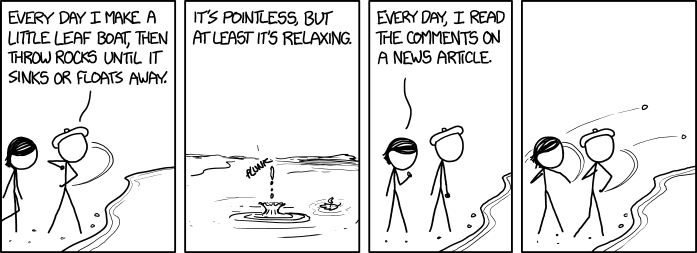
  • Not about academic writing, but the death of James Garner seems to have moderated internet trollery in the comments on the obituaries of him. He seems to have been a decent human being and a good actor, and it was nice for once to scan comments and not see the awfulness of humanity that people usually display there. I shouldn't read comments, but sometimes I get sucked in by them. This comic at xkcd.com says it all, really:

Tuesday, July 15, 2014

Nonacademic books I'd like to write

While working endlessly on this book, I keep fantasizing about the books I would write if I weren't, you know, writing a book.

When I'm struggling with a paragraph ("The subject of this is WHAT? The point of this is WHAT? It's necessary because WHY?"), my brain whispers to me about them.

"If you wrote a biography," it begins, knowing that I like to read them, "you would already have an idea about the structure.  You could spend all your time in an archive. People would line up to buy it, unless, of course, you insist on writing about an obscure author."

"Or," it continues, "you could write one of those books that are about how meaningful it is to read a book and how much it meant to you, like those books about Jane Austen and Middlemarch and Laura Ingalls Wilder. You read. You have opinions, God knows, and a life that has been influenced by books. Why wouldn't people line up to buy your opinions? They buy everyone else's, and maybe you could be charming and funny enough to gain a readership."

Now the brain is really settling into the topic. "Why not a book of academic advice?" it continues.  "Your credentials are about like those of the other academics who give advice, and if you can learn to be more dogmatic, people will listen."

"Or maybe a novel? It might not sell, because you wouldn't want to write about vampires or zombies or space aliens or spies or mysteries or being an academic who can afford to live in Tuscany, but if there's an audience out there for novels where the conflict centers on meting out justice to rude people (hello, Jane Austen fans!), you could write one of those."

"Brain," I say, "shut up. If it were that easy, I would have done it already. And anyway, part of the appeal would be that this would sell."

The brain looks at me, injured.  "Fine," it snaps. "If all you care about is fame and fortune, then you can sell out and see if I care. Go write The 365-Day Cat Golfing Calendar . I'm sure people would line up to buy it," the brain ends with a sneer.

"And if you don't get back to work," it continues, "I'll wake you up at 4 tomorrow morning again so that you can fret for an hour before you get up."

[Edited to add: Wordpress has decided to hate me once again, so WP bloggers, I can't comment on your blogs right now--sorry. I've tried a couple of times at nicoleandmaggie's, etc., but the goddess of WP is implacable right now.]

Thursday, July 10, 2014

Random bullets of a Thursday

  • The nice thing about Twitter is that if someone says something monumentally stupid with a very self-satisfied air, you can just stop following him or her. 
  • Ditto for Captain Obvious statements, of which there are many.  I have gotten very impatient with stupidity this summer, which would be a problem if I saw these people in person at a conference. But if you unfollow, they won't notice you're gone, so no hurt feelings, no harm, no foul.
  • I want to get this piece done, so I can go back to the big project. I apparently don't want to start thinking so that I can write, though.  It's as though I have a gas grill all ready to start but don't want to push the ignition switch. 
  • Profacero's post about productivity made me think about this. I don't have any emotional resistance, though. It's just laziness on my part. 
  • There is just enough daily engagement with the leaning-in part of my new job that I can't ignore university messages.  It nibbles away at the corners of my concentration as if it's pretending not to touch the rest of the cookie. But if you're looking for distractions--as I often am, because: laziness--it's hard not to give it the whole cookie instead of the crumbs.

Tuesday, July 08, 2014

At Chronicle Vitae: Clueless faculty say to grad students "let them eat cake"

At Chronicle Vitae, a select group of STEM faculty are giving the profession the Marie Antoinette* treatment by responding to the jobs crisis as though it's 1968 all over again.  You've heard all these before:
  • "The best students will always succeed."
  • "Students just don't want faculty positions." 
  • “It’s my JOB to create more people like me.
You can read the rest at the link.  Humanities professors aren't quoted in the article.

I'm taking it on faith that these are actual quotations and not random spoutings from an online cliche-generator sponsored by the people who hate tenured faculty, which is what they sound like.

These are the people whose heads would explode if you called them climate-change deniers or quoted them as saying that Adam and Eve walked with the dinosaurs. But how is the failure to recognize this reality for their students any less irresponsible and damaging?


* I know she never said it, but this is kind of a fact-free post, wouldn't you say, so isn't it appropriate?

Wednesday, July 02, 2014

Leaning in means never having to say you're sorry

We've heard a lot of non-apology apologies over the past couple of decades, from the Gulf oil spill "it'll never happen--oh, wait, it did, so deal with it" to the Great Recession ("the economy can't go down--oh, wait, it did, but it's totally the fault of all you unemployed people not spending enough").

I guess I was hoping for better from Sheryl Sandberg, who has apparently reinvented feminism for a new generation. (I dropped my doubts at the door, or rather shelved them,  after seeing how much she meant to women bloggers I respect.)

But really, Sheryl Sandberg? "We never meant to upset you"  is the "Geez, lighten up! I'm sorry that you can't take a joke" of non-apologies.

And then she drags out the old chestnut of every corrupt business everywhere, "we take this very seriously."
"Again, what really matters here is that we take people's privacy incredibly seriously and we will continue to do that."
Yeah, we've seen over and over again just how seriously Facebook takes our privacy. "Seriously" as in changing the security defaults every couple of months to reveal more information? "Seriously" as in making us hunt down the now-hidden controls to go back to more privacy?

I take privacy seriously, too, enough so that I use an entirely different browser for Facebook and use it for nothing else and clear the history and cookies after each session.

And to be willing to mess with people's moods just to sell more junk in the sidebar? When Facebook already has a head start on making people unhappy? 

And not to tell them about it? And then to say, "Meh, what's your problem? That's our business model." That's just wrong.

I think I have had enough this week with corporations being granted more rights than people.  I can't do anything about the Supremes, but I don't have to shop at places that agree with that model, and I don't have to be on Facebook.

And anyone who gives that party line in excusing corporate shenanigans doesn't deserve my trust, even if we are All Women Singing and Leaning In Together.


Tuesday, July 01, 2014

Dear Ms. Undine Answers Your Questions

Dear Ms. Undine,

All the academics I know on Facebook are on vacation or hiking in the mountains or traveling in Europe, having a fabulous time. I am slogging away at writing. I am happy for them but also envious. What do you suggest?  -- Running in Jello

A. Dear Running in Jello,

Stay off Facebook. Sheryl Sandberg wants you to lean in and feel bad, and she's not a bit sorry about it, either.


Dear Ms. Undine,

I am supposed to write in the morning, but if I check email even for a second, I see a lot of messages requiring a reply. Many of them are about things that people want me to do for them. What should I do?  -- Curiosity killed the cat

A. Dear Curiosity,

I saw a message the other day that is just made for you.  It goes something like this: "An email inbox is a to-do list that is made for you by other people. It reflects their priorities, not yours."  If you pay attention to this message and don't check your email until late in the day, you will feel better.

Dear Ms. Undine,

Twitter is full of something called the World Cup and also full of outraged people.  Which do I have to pay attention to if I want to be well-informed about the news?  -- Christiane Amanpour, Jr.

A. Dear Christiane,

Neither.

Dear Ms. Undine,

I keep telling myself "this piece of writing won't write itself," but secretly I think it will if I just leave it alone so that the pages will multiply. Am I right in thinking that the pages will multiply?
-- Hope Springs Eternal

A. Dear Hope,

Sadly, no.  Pages are not like guppies. Instead, they are like books, which will move around on the shelves until you can't find the one you want. There will be the same number of pages that you left, but you will find yourself lost when you go back to them if you don't keep your eyes firmly on them.

If you have questions to ask Ms. Undine, please leave them in the comments.

Friday, June 27, 2014

Creativity Link Roundup: The Brains! The Brains!

Apparently I am thoroughly sick of writing about academic topics this summer, so let's talk, or link to articles about, brains--sweet, nourishing brains.

"So far, this study—which has examined 13 creative geniuses and 13 controls—has borne out a link between mental illness and creativity similar to the one I found in my Writers’ Workshop study. The creative subjects and their relatives have a higher rate of mental illness than the controls and their relatives do (though not as high a rate as I found in the first study), with the frequency being fairly even across the artists and the scientists."  I would only say that, from talking to people who have worked in psychiatric wards, the reverse is not necessarily true: madness does not necessarily mean creativity.
  • "Why Your Brain Needs More Downtime" from Scientific American (and can't we all say a big "amen" to that?). Not only does the brain like to laze around from time to time, but it's a hearty eater: 
By the mid 1990s, however, Marcus Raichle of Washington University in Saint Louis and his colleagues had demonstrated that the human brain is in fact a glutton, constantly demanding 20 percent of all the energy the body produces and requiring only 5 to 10 percent more energy than usual when someone solves calculus problems or reads a book.  . . . Related research suggests that the default mode network is more active than is typical in especially creative people, and some studies have demonstrated that the mind obliquely solves tough problems while daydreaming—an experience many people have had while taking a shower. Epiphanies may seem to come out of nowhere, but they are often the product of unconscious mental activity during downtime. 


  •  "This is Your Brain on Writing" at The New York Times. This one gives a big implicit push to the idea that if you write every day, like a professional writer, you'll actually access different parts of your brain than a novice. 

  • As the scientists report in a new study in the journal NeuroImage, the brains of expert writers appeared to work differently, even before they set pen to paper. During brainstorming, the novice writers activated their visual centers. By contrast, the brains of expert writers showed more activity in regions involved in speech. 
    “I think both groups are using different strategies,” Dr. Lotze said. It’s possible that the novices are watching their stories like a film inside their heads, while the writers are narrating it with an inner voice. 
    When the two groups started to write, another set of differences emerged. Deep inside the brains of expert writers, a region called the caudate nucleus became active. In the novices, the caudate nucleus was quiet. 

    The caudate nucleus is a familiar part of the brain for scientists like Dr. Lotze who study expertise. It plays an essential role in the skill that comes with practice, including activities like board games.
    • Scientific American's blog informs us that there is no such thing as right brain/left brain activity: 
    • In a recent large review, Rex Jung and colleagues provide a “first approximation” regarding how creative cognition might map on to the human brain. Their review suggests that when you want to loosen your associations, allow your mind to roam free, imagine new possibilities, and silence the inner critic, it’s good to reduce activation of the Executive Attention Network (a bit, but not completely) and increase activation of the Imagination and Salience Networks. Indeed, recent research on jazz musicians and rappers engaging in creative improvisation suggests that’s precisely what is happening in the brain while in a flow state.


  •  And because I can never let this alone as a topic, a reprise of "What's Lost as Handwriting Fades" at the New York Times: 

  • But psychologists and neuroscientists say it is far too soon to declare handwriting a relic of the past. New evidence suggests that the links between handwriting and broader educational development run deep.
    Children not only learn to read more quickly when they first learn to write by hand, but they also remain better able to generate ideas and retain information. In other words, it’s not just what we write that matters — but how. 
    “When we write, a unique neural circuit is automatically activated,” said Stanislas Dehaene, a psychologist at the Collège de France in Paris. “There is a core recognition of the gesture in the written word, a sort of recognition by mental simulation in your brain. 
    “And it seems that this circuit is contributing in unique ways we didn’t realize,” he continued. “Learning is made easier.

    Monday, June 23, 2014

    Do you remember (and share) your dreams? A sort-of poll.

    Still not ready to write a real post, but after Spouse patiently listened to another of my dreams, he offered this: "You know, in talking to various men, they all say that their wives tell them their dreams but that they rarely dream or rarely remember it if they do." Obviously dreaming itself can't be a gender-linked thing, but what about remembering dreams and wanting to tell someone about them?

    So, commenters: Do you remember your dreams? Do you tell them to someone or maybe write them down?

    Wednesday, June 18, 2014

    Is it done yet?

    It's the phrase you love to hear, because it means that someone is paying attention to the infernal manuscript, and the phrase that, next to "are we there yet?", you probably hate the most, if you have to answer "no."

    I am in the same boat as Dr. Crazy: not writing on the blog, despite that long post on Joyce Maynard/J.D. Salinger, because I'm trying to get writing done. And like her, I've figured out some things I can ignore.

    • CHE, which I usually take a break from anyway in the summer, and ChronicleVitae. My admittedly writing-obsessed and  very possibly writing-cranky self now looks at the headlines at CV and goes down the list: "Knew that. Knew that 20 years ago. You didn't know that? Nope, you didn't invent that. Yup, that's true. Nope, you're wrong." Finally, I realized that CV is for new academics, not mid-career ones, and now CV is going on the banned-for-summer list too. 
    • TV, at least normal non-Netflix TV and most of Netflix, too. 
    • Premature election coverage, A.K.A. all election coverage at this point. 

    Things I can't ignore:

    • July deadlines.
    • Getting out of the house and getting some exercise, unless I want to resemble you-know-who from Back to the Future. 


    Saturday, June 14, 2014

    Off-topic: Mid-century Male Writers, Salinger edition

    -->
    Apparently my reading for pleasure these days involves revisiting some of the twentieth-century writers, the Mid-Century Males, that I read back as an undergraduate. J. D. Salinger is one; isn't he for everyone at that age? Catcher in the Rye was okay, but in a short story class we read (and I reread many times) Nine Stories, later discovering on my own, like just about every late adolescent everywhere, Franny and Zooey, my favorite of his works. 
    Recently, I saw the Salinger documentary and checked out of the digital library Kenneth Slawenski's Salinger: A Life, Joanna Rakoff's My Salinger Year, and, because the other sources mentioned it, Joyce Maynard's At Home in the World. Apparently I was the last person on earth to have read Joyce Maynard years ago without knowing about The Salinger Connection, so I wasn't influenced by that when I read her.
    Slawenski's book made much of Salinger's horrific WWII experiences, which started on D-Day and ended 299 days later after he helped to liberate concentration camps, something that the documentary emphasizes with a whole lot of (deservedly, I suppose) portentous music. Rakoff's My Salinger Year is delightful. It's a memoir of her year in the mid-1990s working at The Agency (Harold Ober and Associates) and handling both Salinger's fan mail and her employers' charmingly eccentric terror about encroaching technology. It's 1996, but the IBM Selectric is still king of the office.
     Maynard's book is similar to the first two of hers that I read years ago (Baby Love, Looking Back).  She's a keen observer of her own life, but only of her own life, and only of herself as the primary person within it. As she says many times in At Home in the World, she's not a reader, and she doesn't seem to be able to make those connections except through pop culture, although she's very good at the specifics of that. When she reports incidents like threatening to cut off her long braided hair and her husband Steve saying, "It's your hair," the implication is that he's too stolid and isn't paying sufficient attention to her misery. Less sympathetic readers might think that she's being a drama queen. That doesn't prevent her from making some good observations, though.
    The whole Salinger thing that she was pilloried for is only a part of the book, and apparently, in another interwebs development I totally missed, everyone is in a pro- or anti-Maynard camp: either "How dare you malign The Great Man?" or "How dare The Great Man have acted so cruelly toward women?"  Maynard's take on the relationship, in the new preface, is not so much "what was I thinking to quit Yale and move to New Hampshire with Jerry Salinger?" as "how could he violate my innocence by overpowering me with his adoration? Shouldn't we think of 18-year-olds as girls instead of women?" It's a fair question, but really, who could have stopped her or any of us at 18? That's not a hornet's nest I'm willing to wade into in this space.  
    Salinger's writing advice--which is why I read the book--is actually sound. Salinger on writing: he writes every day, and by about 6.30 a.m. he's in his writing room, later apparently the famous writing bunker where he would stay for weeks at a time. He shows Maynard at least two manuscripts but says that writing for publication is all just ego and being of the world, which he condemns.  Given that Salinger seems to have had the biggest ego in the Western Hemisphere, this is a little disingenuous, but all right. The documentary says that there are books lined up to be published in 2015 and beyond.
    Here's the thing that struck me, wanting as I did the details of the writing life: Maynard and Salinger eat their breakfast of thawed frozen peas and then both of them go off to their writing tasks.  Maynard never mentions that in the memoir; it only comes up in an interview in the past couple of years.  Two writers, living in a house together: that's the portrait that the interview gives and that she's trying to avoid. Yet elsewhere she describes her writing routine, and she's a remarkably disciplined and productive writer.
    Instead, the memoir section about her life with Salinger is all about making herself small, about buying a sewing machine and cooking badly and leaving her stuff strewn around the house and feeling wounded and above all not writing the memoir she's been contracted to write. It's clear that she did feel diminished by his treatment, as who wouldn't? Yet by the end of the year, the memoir has magically been written, with an epilogue heavily influenced and partly written by Salinger himself because she wasn't being specific and honest enough about what she was writing.
    That's the frustrating part of this memoir: it has the wrong focus, or maybe the right focus for Maynard but the wrong focus for someone who wants to read about writing. Even though the focus of any Maynard book is always going to be Maynard, front and center, she zeroes in on her father's alcoholism and her mother's weird obsession with her as defining, formative moments.  No doubt they were, but this makes the whole thing come off as another of innumerable recovery/abuse memoirs. She has had the experiences, though, and the talent to make more of the memoir than this. 
    What I wanted to see more of was the narrative that's trying to emerge here and can't, of Salinger trying to teach her something about writing and the approach that writers have to take to make it mean something. It has to be honest and something you care about, he tells her; there's no glory in taking pot shots and writing snark about beauty contests and Pillsbury Bake-Offs, although she does.  Salinger warns her about this and about adopting her mother's voice as she has adopted her mother's methods of applying to contests, pitching stories, etc.

    When she shows up at Salinger's door in 1997--which I think took a lot of courage, by the way--he tells her that she had the capacity to become something but has become nothing, or something like that. She's obviously made something of herself, having had a successful career,  and she is a survivor, but is there anything in what Salinger says? Or is this just another case of a powerful man falling in love with an image that he creates and trying to destroy the image when she turns out to have a voice of her own?

    Friday, June 13, 2014

    Friday randomness


    • All the writing energy is going into the endless project, except that I'm now excited about it. 
    • I sent two pieces of it this week so now someone besides me will read it. 
    • Then it was time to do all the errands: call Kabletown about lowering the cable bill, which will happen, and pick up dry cleaning, and get car serviced, and get groceries so that there is more than kale and cheese in the house.  Pro tip: No one can live solely on Cheesy Kale Delight or Kaley Cheese Delight or any permutation thereof.  It's been tried. 
    • I am getting increasingly annoyed with news sites reporting celebrity gossip as though it is as important as the tragic mass shootings we have seen lately. Double that for calling the perpetrators "shooters." "Shooters" is for video games. These people are murderers. 

    Tuesday, June 10, 2014

    Random writing points for a Tuesday


    • If you wake up naturally at 4:30 a.m., consider that the summer's early light is telling you something. You can get a lot done of writing done then. 
    • Writing makes me hungry, and not the faux "let's avoid this paragraph by seeing what is in the refrigerator" kind of hungry. I'm talking light-headed and stomach-growling hungry every few hours. Is it because of the brain using up glucose? I've taken to eating smaller meals more often. In case you were wondering: none of this results in any weight loss.
    • I wish there were a Hallmark card that you could send to say, "I'm sorry I'm not getting it done as fast as you'd like it to be done, but I'm working really hard on it--honest."
    • You can trim down a long chapter by a lot if you read it paragraph by paragraph and ask yourself two things: 
      • What's the subject of this paragraph? 
      • And what's the point of this paragraph? 
      • I figure I should be able to write a 1-word tag for the subject, but if I can't identify how the second contributes to the argument, it gets condensed, moved, or chopped.
    • I have been gleefully ransacking my files for my old manuscripts, things I've reviewed, and so on.  Why? For the paper, not the great thoughts contained therein. Everything that's not already printed double-sided goes into the maw of the printer for printing drafts on the clean side.  And my files get cleaned out, too.  Win-win!

    Friday, June 06, 2014

    Still here

    A conference, some deadlines, more travel, a hectic week, and then some more deadlines.  News I thought about writing about but didn't:
    • At The New Yorker, the case for banning laptops in the classroom (wait--I already did that). More on this from WaPo and Margaret Soltan. [Edited to add links.]
    • Cursive handwriting improves learning.
    • The MLA recognizes a jobs problem but touchingly believes that (1) 60% of graduates get jobs and (2) that jobs are going begging in museums, libraries, and nonprofits, all of which will snap up vast numbers of English Ph.D. graduates immediately if we can (3) lower the time to degree and provide different sorts of training without (4) diminishing the number of graduates.  
    • Quick quiz: which of these items is probably true?  Answer: 3. Joshua Rothman at The New Yorker does a quick check of the MLA's math.
    • Mad Men, although that may be yesterday's news. 
    A real post soon.