Theory
Q: What is the purpose of service at the institutional and professional level?
A: To ensure the smooth functioning of all academic pursuits: tenure, promotion, hiring, curriculum, assessment, conferences, and the advancement of scholarship by professional organizations.
Q: What is the effect of service at the institutional and professional level?
A: To suck up time--entire days and associated brainpower--that should be devoted to writing.
Q: Can service be completed in chunks of time so that you can ignore importunate emails during your writing time?
A: Not necessarily.
Q: What are the rewards of service? (Choose all that apply.)
A: (1) Promotion, (2) tenure, (3) status in the field (4) the gratitude of your peers, and (5) the knowledge that you're helping and are not being a slacker.
Q: Why do you participate in service activities? (Choose all that apply.)
A: (1) Promotion, (2) tenure, (3) status in the field (4) the gratitude of your peers, (5) the knowledge that you're helping and are not being a slacker, and (6) I'm just a girl who can't say no.
Q: Whose fault is it if service obligations eat into your time? (Choose all that apply.)
A: (1) Those who ask you to do the service and (2) yours. You can't control (1) but you can control (2) a little bit by saying no to some things.
Application
Did I say no to something this week that would have hugely inconvenienced me and sucked up a lot of time and energy in order that someone else would have all the benefit of it?
Did I refuse to travel somewhere and destroy a writing day so that I could be an appreciative audience for something that was not necessary? (Hint: Killing a writing day so I can go sit in an audience somewhere is one of my least favorite parts of service responsibilities.)
Yes. Yes, I did.
Do you feel guilty about it?
Nope--not a bit.
Friday, January 27, 2012


Saturday, January 21, 2012
Term Papers vs. Blogs and Cathy Davidson vs. the NYTimes
Over at HASTAC, Cathy Davidson has written a great defense of her assertion that term papers should be abolished in favor of blogs. Like a lot of great lines, it was provocative, good copy, and not what she actually said, apparently (hey, academic superstar celebrities need publicity, too!).
Matt Richtel at the NYTimes is having none of it, suggesting that unnamed "defenders of traditional writing" propose a "reductio ad absurdum: why not just bypass the blog, too, and move right on to 140 characters about Shermn’s Mrch?" which Davidson rightly says is unfair.
I'm all for student-written blogs. I've been using them in classes for 10 years, and I think their use has helped students' writing, something that real researchers of this like Andrea Lunsford have confirmed (see Davidson's piece). I agree with all she says about students writing more and being more engaged when they're writing something they're (1) passionate about and (2) writing for a broader audience than just the teacher, which is what a blog gives you. Davidson's argument is attractive, and, in fact, is well established in the last 30+ years of writing pedagogy. Remember Ken McCrorie's Telling Writing and his (I think) railing against the comically stultified prose he called "Engfish"?
I guess I just have one question: what does Davidson mean by a "term paper"? I wrote something called a "term paper" in high school, but that was back when we incised the characters in cuneiform onto wet clay. "Term paper" seems to be the new whipping boy of writing alongside its maligned cousin, the five-paragraph essay, but are these really assigned in the same deadening way that she describes?
I'd never assign a "term paper" of the kind that she vilifies, but I would and routinely do assign papers that require an argument, with a thesis and evidence from the text and external sources. Students ought to be able to construct an argument and support it, shouldn't they?--and if they shouldn't, then why does Davidson couch her post about the issue in exactly that form?
The thing is, if you are in any kind of job that requires writing at all, you have to learn to write in a whole lot of different forms, including resumes and cover letters (her examples). You learn to see the conventions of these forms by writing in them and by seeing that conventions differ but that some good qualities of writing remain across them all. Isn't that what we're trying to get our students to see?
Despite the dramatic contrasts in which it's being framed by Davidson and the media, I guess I don't see this as a blogs vs. papers issue. What's wrong with "blog post -> short reading of a text -> longer argument -> presentation -> another blog post"? Or some other combination? Writing is a continuum, not an either/or.
Your thoughts?
Matt Richtel at the NYTimes is having none of it, suggesting that unnamed "defenders of traditional writing" propose a "reductio ad absurdum: why not just bypass the blog, too, and move right on to 140 characters about Shermn’s Mrch?" which Davidson rightly says is unfair.
I'm all for student-written blogs. I've been using them in classes for 10 years, and I think their use has helped students' writing, something that real researchers of this like Andrea Lunsford have confirmed (see Davidson's piece). I agree with all she says about students writing more and being more engaged when they're writing something they're (1) passionate about and (2) writing for a broader audience than just the teacher, which is what a blog gives you. Davidson's argument is attractive, and, in fact, is well established in the last 30+ years of writing pedagogy. Remember Ken McCrorie's Telling Writing and his (I think) railing against the comically stultified prose he called "Engfish"?
I guess I just have one question: what does Davidson mean by a "term paper"? I wrote something called a "term paper" in high school, but that was back when we incised the characters in cuneiform onto wet clay. "Term paper" seems to be the new whipping boy of writing alongside its maligned cousin, the five-paragraph essay, but are these really assigned in the same deadening way that she describes?
I'd never assign a "term paper" of the kind that she vilifies, but I would and routinely do assign papers that require an argument, with a thesis and evidence from the text and external sources. Students ought to be able to construct an argument and support it, shouldn't they?--and if they shouldn't, then why does Davidson couch her post about the issue in exactly that form?
The thing is, if you are in any kind of job that requires writing at all, you have to learn to write in a whole lot of different forms, including resumes and cover letters (her examples). You learn to see the conventions of these forms by writing in them and by seeing that conventions differ but that some good qualities of writing remain across them all. Isn't that what we're trying to get our students to see?
Despite the dramatic contrasts in which it's being framed by Davidson and the media, I guess I don't see this as a blogs vs. papers issue. What's wrong with "blog post -> short reading of a text -> longer argument -> presentation -> another blog post"? Or some other combination? Writing is a continuum, not an either/or.
Your thoughts?
Friday, January 20, 2012
Random bullets of Friday
Until I can muster the brainpower for a post on Apple's education initiative, here are some random bullets.
- Blogspeak is already serving as a placeholder in what I'm writing. I just reread a section in which I said that a character "was in dire need of an ethics makeover," which, while true, doesn't exactly pass for scholarly prose these days--or does it?
- My resemblance to Jean-Luc Picard may end at our mutual fondness for Earl Grey tea, but I wish I had one power that he had: the one where you say "make it so" and some minion does it. I'm thinking especially of scheduling meetings, which even with online scheduling software where people put in their preferences is a process with far too many to-and-fro messages and far too much wasted mental energy. This includes the gentle reminders to those who refuse to put in their schedules but greet every announcement of a meeting with "I can't meet at that time!" If I were Jean-Luc, I would say "Schedule a meeting. Send the documents. Book the room. Make it so." and it would be done. Actually, I would just say "Schedule the meeting. Make it so" and the minion would intuit the rest, instead of my wasting two entire writing days on scheduling and meetings this week.
- Speaking of Apple, I recently joined the Cult of Steve after yet another Sony computer's hard drive bit the dust
one yeartwo years after purchase, apparently taking some programs with it. It would warn me that I ought to back things up to the external hard drive, since the hard drive was failing, and, when I tried, gave an error message equivalent to "Nuh-uh, can't back this up. Fail!" With Dropbox, I still have almost all of my documents, but the lost email files would sure be nice to have. On the plus side, I'm still using the speakers and subwoofer from a computer I bought 12 years and 3 computers ago, which work with Steve's creation just fine. - In addition to my slow learner status re: the short life of planned-obsolescence Sony products and my vow never to buy another one, I had been introduced to the Cult of Steve by gateway drugs such as the iPad and iPhone. Now it seems normal to have to hunt for files and be frustrated (but less so every day) by the inscrutable workings of a machine run by Powerful Beings who purport to know better than I do where my pictures ought to be hidden. (I'm allowed to tag them; I just can't find them.) It's good training for dealing with bureaucracies, anyway.
Friday, January 13, 2012
On writing: Starting over after a hiatus
It may not be exactly "starting over," but the poor book ms., abandoned in the flurry of MLA and associated paper-writing, not to mention the holidays and the start of classes, must feel, well, neglected.
How to begin again? Here's the plan:
(1) Print it out. Reading on the screen just doesn't give me the same perspective, and I will recycle the paper, so yes, that's necessary.
(2) Read it--all of it--while resisting the temptation to fix things at the sentence level.
(3) Go back through the research journal (printed version) and see what I've forgotten or missed. Highlight those parts and put an X through what's already done.
(4) Assess the roughest parts of more or less finished chapters and list the improvements needed--and then leave them alone for now.
(5) Generate some actual new text on the chapters not yet started and rough in some sections on the half-finished chapters.
(6) Go back to the "write every day" plan, even if that means using 750words.com again, since that really did help to establish the habit.
(7) Rev up the Excel chart again, since that acts as a conscience in tabular form.
As part of this new plan, I also have two resolutions:
(1) I'm going to try to reserve the computer where I write for writing and class work, not reading distraction sites.
(2) I want to have a complete draft of my next conference paper done at least 3 weeks before the next conference.
How to begin again? Here's the plan:
(1) Print it out. Reading on the screen just doesn't give me the same perspective, and I will recycle the paper, so yes, that's necessary.
(2) Read it--all of it--while resisting the temptation to fix things at the sentence level.
(3) Go back through the research journal (printed version) and see what I've forgotten or missed. Highlight those parts and put an X through what's already done.
(4) Assess the roughest parts of more or less finished chapters and list the improvements needed--and then leave them alone for now.
(5) Generate some actual new text on the chapters not yet started and rough in some sections on the half-finished chapters.
(6) Go back to the "write every day" plan, even if that means using 750words.com again, since that really did help to establish the habit.
(7) Rev up the Excel chart again, since that acts as a conscience in tabular form.
As part of this new plan, I also have two resolutions:
(1) I'm going to try to reserve the computer where I write for writing and class work, not reading distraction sites.
(2) I want to have a complete draft of my next conference paper done at least 3 weeks before the next conference.
Monday, January 09, 2012
Random Bullets of MLA 2012
- Seattle, a no-snow and nearly a no-coat-needed city. Also, Pike Place Market, restaurants, and for the fans, two Starbucks stores on every corner. Great choice, MLA planners!
- Free wireless in the conference room block, in the well-lighted convention center, in the Sheraton session rooms--a godsend. The password was still a mystery for a while: It seemed to be passed from person to person, or so someone told me, and when I arrived at one session all ready to tweet it, I couldn't get in because I hadn't thought to ask someone for the password.
- Better spirits all around. Last year was all about the grim job market, or so it seemed. There was a lot of optimism in the air this year: better job market, enthusiasm about digital humanities, well-attended alt-ac sessions. People looked hopeful, or maybe it was just all that Starbucks caffeine causing those smiling faces.
- Really good sessions and papers.
- Lots of iPads and laptops, including use by presenters.
- Good tech support for presenters: there was a try-out room, and the technicians came by to check whether the laptops would project before tech-using sessions.
- Saw Rosemary Feal from afar at the big events and learned that her name is pronounced Fay-AL.
- Learned that the Twitter feed is best read judiciously, since it induces "I should have been there" session envy regardless of how fantastic the session is that you attended.
- Some sessions were tweeted by multiple people, but other great sessions weren't tweeted at all. Am not sure whether the tweeters are organized in some way so that the tweeting is distributed among sessions or whether they're all just voluntarily tweeting from sessions they'd be attending anyway.
- When people sit at the twitter/laptop table set up in the back of a room, I keep expecting them to hold up signs at the end of each paper: 5.5, 5.9, 6.0.
Monday, January 02, 2012
The Peter Principle of Software Development
A quiz for software developers.
1. If a feature has proven to be especially useful to users in the past, you should
a) Get rid of it.
b) Rename it so that users will not know where to find it (Preview developers, I'm looking at you. Why transform "Save as" into Export? Why?)
c) Surround it with three new pointless "features" that no one would ever want to use.
2. A feature is simple to get to in an earlier version, requiring only two clicks of a mouse. The next version of the software should require how many clicks to access the same feature?
a) Three
b) Five
c) Five plus a Google search for where to find the feature
3. If a feature is accessible through a fast keystroke combination, what should you do in the next version?
a) Make it accessible only by drop-down menu accessed from a mouse, so that it takes longer
b) Make it accessible only with a mouse AND rename it
c) Make it accessible only via the mouse AND tell the user to go remap the keyboard or write a macro if she's so keen to use keystrokes. Keystrokes are for peasants.
4. Should you, under any circumstances, explain how to do things in the users' manual?
a) Hahahahahahah--what a comedian you are!
b) What users' manual? You mean the giant .pdf with lawyers' warnings that tell me not to use the laptop as a tray to carry hot coffee and not to put the mouse in my mouth--in six languages?
c) No. Users' manuals build community by forcing people to Google the problem and find out the answer on various tech forums.
5. If a user minimizes or shuts down some feature by mistake, causing it to vanish, how long should it remain invisible to the user?
a) Forever. If you didn't write down what the feature was called--hey, your loss. Learn to work without it. It builds character.
b) It depends on the feature. If it's one that the user might want to use, forever, but if it's some pointless frill like sharing your private information with Facebook, it should pop up again and again.
6. For website developers: when designing a site where users have to enter important information that counts for something, should you have pointless pop-ups asking the user to donate money/consider visiting another site/choose between two equally incomprehensible options before continuing?
a) yes
Anything else you'd like to add to the quiz?
Saturday, December 31, 2011
Taking stock at year's end
All around the blogosphere, there are fabulous and funny roundups at this year's end. If I take stock the way I do after a class is over, what do I want to see more of or less of in 2012?
1. More acceptance and fewer regrets. By nature I can't make decisions, and when I do, I second-guess myself for literally decades. What if I'd done X or said no to Y? What if I hadn't resigned from Z task? Logic doesn't enter into it, and reflecting on the decisions just leads to pits of regret regardless of the reality that my decision may have been the right one. This year, I said no to more invitations and felt all right about it. That's progress.
2. More recognition of the fact that writing may be easy, but thinking is hard. I'm paraphrasing something profacero once said about writing being easy, because while certain kinds of writing are a real pleasure, others are tough. I'm thinking of some pieces I wrote that were based on archival materials, and the writing of them was just a joy--like writing a narrative--whereas what I've been wrestling with this year are ideas that reconceive some important things in my research area, and in that wrestling match, the ideas got the better of me more than once. I haven't written as much this year, but I've thought my way through some things that should prove fruitful (they'd better!) in 2012.
3. More attention to things I can do something about, and less attention to things I can't. Example of where attention matters: I lost about ten pounds just by paying attention to whether I was really hungry when I ate something. Example of where it doesn't: Watching the contest of political candidates vying for attention by appealing to the lowest common denominator of stupidity in the American public. Paying attention to what people call themselves or profess to be when their actions are what count.
1. More acceptance and fewer regrets. By nature I can't make decisions, and when I do, I second-guess myself for literally decades. What if I'd done X or said no to Y? What if I hadn't resigned from Z task? Logic doesn't enter into it, and reflecting on the decisions just leads to pits of regret regardless of the reality that my decision may have been the right one. This year, I said no to more invitations and felt all right about it. That's progress.
2. More recognition of the fact that writing may be easy, but thinking is hard. I'm paraphrasing something profacero once said about writing being easy, because while certain kinds of writing are a real pleasure, others are tough. I'm thinking of some pieces I wrote that were based on archival materials, and the writing of them was just a joy--like writing a narrative--whereas what I've been wrestling with this year are ideas that reconceive some important things in my research area, and in that wrestling match, the ideas got the better of me more than once. I haven't written as much this year, but I've thought my way through some things that should prove fruitful (they'd better!) in 2012.
3. More attention to things I can do something about, and less attention to things I can't. Example of where attention matters: I lost about ten pounds just by paying attention to whether I was really hungry when I ate something. Example of where it doesn't: Watching the contest of political candidates vying for attention by appealing to the lowest common denominator of stupidity in the American public. Paying attention to what people call themselves or profess to be when their actions are what count.
What else? High hopes for more exercise, more writing, more energy, more good spirits-- and wishing the same to everyone else on New Year's Eve!
Tuesday, December 27, 2011
Post-Christmas
The holiday was lovely. Family, here and on the phone from distant places. People playing the piano.
Looking out the window at that blue light in the atmosphere that comes just after dusk, when the only thing you can see clearly is the white snow and the shape of the trees.
And cookies. I can usually take them or leave them alone, but there's a kind of Christmas sugar cookies with confectioner's sugar glaze that are basically like crack to me. Fortunately, I ate up the rest and thought about Oscar Wilde's "the only way to get rid of temptation is to yield to it." Oh, Oscar. If you only knew.
Merry Christmas and happy holidays, everyone!
Looking out the window at that blue light in the atmosphere that comes just after dusk, when the only thing you can see clearly is the white snow and the shape of the trees.
And cookies. I can usually take them or leave them alone, but there's a kind of Christmas sugar cookies with confectioner's sugar glaze that are basically like crack to me. Fortunately, I ate up the rest and thought about Oscar Wilde's "the only way to get rid of temptation is to yield to it." Oh, Oscar. If you only knew.
Merry Christmas and happy holidays, everyone!
Thursday, December 22, 2011
Soothing things
What we want is . . . soothing things. Cookies. Maybe some more cookies. Maybe some tea, quiet music, and sitting by the fire.
Maybe to wander around the books on our shelves, take one down that has nothing to do with projects at hand, and read just for the fun of it.
From Mark Twain (culled from various essays and speeches):
Maybe to wander around the books on our shelves, take one down that has nothing to do with projects at hand, and read just for the fun of it.
From Mark Twain (culled from various essays and speeches):
- "Always obey your parents, when they are present."
- "Yes, one of the brightest gems in the New England weather is the dazzling uncertainty of it. There is only one thing certain about it, you are certain there is going to be plenty of weather--a perfectly grand review; but you can never tell which end of the procession is going to move first. . . . The lightning there is peculiar; it is so convincing. When it strikes a thing, it doesn't leave enough of that thing behind for you to tell whether--well, you'd think it was something valuable, and a Congressman had been there."
- "That awful power, the public opinion of a nation, is created in America by a horde of ignorant, self-complacent simpletons who failed at ditching and shoemaking and fetched up in journalism on their way to the poorhouse."
- "If a person offend you, and you are in doubt as to whether it was intentional or not, do not resort to extreme measures; simply watch your chance and hit him with a brick."
- [On the last words of great men.] "Now there was Daniel Webster. Nobody could tell him anything. He was not afraid. He could do something neat when the time came. And how did it turn out? Why, his will had to be fixed over; and then all his relations came, and first one thing and then another interfered, till at last he only had a chance to say 'I still live,' and up he went. Of course, he didn't still live, because he died--and so he might as well have kept his last words to himself as to have gone and made such a failure of it as that."
- "I have been a correct speller, always; but it is a low accomplishment and not a thing to be vain of. Why should one take pride in spelling a word rightly when he knows he is spelling it wrongly? . . . .Yes, there are things which we cannot learn, and there is no use fretting about it. I cannot learn adverbs; and what is more I won't."
- "The fact is, as the poet has said, we are all fools. The difference is simply in the degree. The mercury in some of the fool-thermometers stands at ten, fifteen, twenty, thirty, and so on; in some it gets up to seventy-five; in some it soars to ninety-nine. I never examine mine, --take no interest in it."
Do you have more suggestions for soothing things at this time of the year?
Wednesday, December 21, 2011
Random bullets of preparing for the holidays
- The nice thing about this time of year is that you can give in to your impulses to do the most soothing activity on earth: baking.
- I know that administrators and support staff are still in the office, but grades are in (hooray!) and I am not. Do you really think I'm going to work on task force/committee/other service things this week? No? Then why do you keep sending me things? I'm guessing it's the "tennis ball school of time management": you lob it to my desk so it's off your desk.
- After all these years, I actually associate listening to holiday music with working on papers for MLA. How sick is that?
- The "buy local" thing is going pretty well, but I would like to give retailers once piece of advice: if you are any store that does not cater to children, playing Alvin and the Chipmunks as holiday music is a surefire way to send adults scurrying for the exits whether they've bought their virtuous local goods or not.
- About buying local: yes, some things cost more than on Amazon. I just bought fewer things this year. It's not about things.
- Technology brings us many gifts this time of year, including this one: If you are going to MLA and are not yet anxious about it, just check out anything on Twitter with an MLA hashtag. I guarantee you will start to fret and hyperventilate--or is that just me and is everyone else excited about it?
Monday, December 19, 2011
Automated learning: MITx and online certificates
According to an article at The Chronicle, "MIT Will Offer Certificates to Outside Students Who Take Its Online Courses." , MIT is going to start offering certificates to--well, the headline tells you about it.
In one way, this is a positive step toward making learning, especially in technical subjects, available to more people, people who couldn't attend/be accepted into/afford MIT. They'll earn the certificates in this way: "They'll watch videos, answer questions, practice exercises, visit online labs, and take quizzes and tests. They'll also connect with others working on the material." As open courses, these could be hugely popular: 94,000 people enrolled in just one course (yes, one course) offered by Stanford last fall. The course will be as rigorous as a regular course, we're told. These are MOOC courses.
As always, the sticking point is assessment: how will the learning in the course be evaluated, and by whom?
Short answer: "It's unclear exactly how the assessment will work."
Longer answer: Technology and teaching assistants will be our saviors.
But automated essay grading? Crowdsourced grading and the pointlessness of writing essays at all have already made their way into the conversation. Possibly MIT is thinking of anonymous grading along the lines of "the grading factory" or of outsourcing grading as business school professors are doing. Certainly some science instructors are enthusiastic about programs like SAGrader.
An essay grading program may not have the emotional kick of having a student come up at the end of the semester to thank you for helping her improve her writing, as happened to me and other bloggers recently, but MIT seems to say that the efficiency tradeoff is worth more than the emotional connection.
And if teaching assistants and adjunct tutors are the solution: does the profession really need to find MORE ways to exploit TA's and adjuncts? I'm guessing that only an Einstein in training is going to make it to the top of the question pyramid that MIT describes and that overworked and underpaid temporary faculty are going to do the bulk of it, without ever getting the satisfaction of having seeing individual students improve, unless they have a better memory for 94,000 names than I do.
I'm not saying this isn't the wave of the future; it might be. I'm not saying this can't work; for technical fields, it might. I don't know enough to say.
But if it's the wave of the future, why is MIT so careful to "distance" this "brand" from its own brand of education?
In one way, this is a positive step toward making learning, especially in technical subjects, available to more people, people who couldn't attend/be accepted into/afford MIT. They'll earn the certificates in this way: "They'll watch videos, answer questions, practice exercises, visit online labs, and take quizzes and tests. They'll also connect with others working on the material." As open courses, these could be hugely popular: 94,000 people enrolled in just one course (yes, one course) offered by Stanford last fall. The course will be as rigorous as a regular course, we're told. These are MOOC courses.
As always, the sticking point is assessment: how will the learning in the course be evaluated, and by whom?
Short answer: "It's unclear exactly how the assessment will work."
Longer answer: Technology and teaching assistants will be our saviors.
But how much will outside individuals get to interact with MIT professors? That's unclear.This sounds as though it might work in technical fields, where I'm assuming you have some fixed, highly complex content that has to be mastered. I don't have enough content knowledge about those fields to say. It has an advantage in that we're all used to using online forums, responding, and rating good answers highly. It's satisfying to help someone online, and this model would take advantage of that knowledge.One way to promote such contact will be software that handles many questions, said Anant Agarwal, director of MIT's Computer Science and Artificial Intelligence Laboratory.
"Through voting and other mechanisms, you can create a funnel of requests so that the requests that come off the funnel at the very top can actually be answered by MIT professors and MIT TA's," he said. "A large number of questions at the lower parts of the funnel can actually be answered by other learners who may be slightly ahead."
MIT faculty members have also developed technology that can automatically grade essays. Other technologies that could come into play here include automatic transcription, online tutors, and crowdsourced grading.
But automated essay grading? Crowdsourced grading and the pointlessness of writing essays at all have already made their way into the conversation. Possibly MIT is thinking of anonymous grading along the lines of "the grading factory" or of outsourcing grading as business school professors are doing. Certainly some science instructors are enthusiastic about programs like SAGrader.
An essay grading program may not have the emotional kick of having a student come up at the end of the semester to thank you for helping her improve her writing, as happened to me and other bloggers recently, but MIT seems to say that the efficiency tradeoff is worth more than the emotional connection.
And if teaching assistants and adjunct tutors are the solution: does the profession really need to find MORE ways to exploit TA's and adjuncts? I'm guessing that only an Einstein in training is going to make it to the top of the question pyramid that MIT describes and that overworked and underpaid temporary faculty are going to do the bulk of it, without ever getting the satisfaction of having seeing individual students improve, unless they have a better memory for 94,000 names than I do.
I'm not saying this isn't the wave of the future; it might be. I'm not saying this can't work; for technical fields, it might. I don't know enough to say.
But if it's the wave of the future, why is MIT so careful to "distance" this "brand" from its own brand of education?
Sunday, December 18, 2011
Thinking about next time at semester's end
As I'm getting ready to post grades (now all in--yay!), I look at the Excel spreadsheet and it talks to me.
- Why, oh, why, didn't student X show up more and, you know, make an effort? S/he should have been an A student.
- Next time, don't be so tenderhearted in marking their first papers.
- Really, you made that assignment worth THAT much?
- Next time, arrange the semester so that you're not giving up writing for grading for the last three weeks of it.
And now it's time to get back to writing, which fell off hugely once I stopped doing the 750words thing.
Tuesday, December 13, 2011
Don't be evil, Amazon, and abandon your scorched-earth policy
You've probably seen this already, but if you haven't, go read Richard Russo's "Amazon's Jungle Logic" at the NYTimes: http://www.nytimes.com/2011/12/13/opinion/amazons-jungle-logic.html?_r=1&hp.
In a new low in shopping promotions, Amazon is giving shoppers a discount if they go into a brick-and-mortar store, compare prices on an item using some price-compare app, and then buy the thing on Amazon.
On a world-affairs scale, that may not amount to much evil, but on an everyday-consumer-life scale, that's evil. It's even ratcheting up a notch the ethically dubious practice endorsed by staid old and usually not corrupt Consumer Reports of test-driving a car or checking out consumer electronics at your local dealer and then ordering it online to save money.
Here's a tip: those brick-and-mortar stores don't exist as free showrooms for online businesses, although Amazon.com would like to think they do. If we keep using them that way, pretty soon those free showrooms won't exist, especially in the book world. You won't stumble on books or find a gift by looking around a store filled with books, because there won't be one near you.
I still do buy from Amazon.com, especially when it's some book of lit crit that no indy bookseller would have or when sending a gift that would mean an hour in line at the post office. But I turned the tables on Amazon by printing out the "wish lists" of gift recipients. I plan to head down to the friendly independent bookseller with those lists later this week--and I won't be doing so with any Amazon Judas app in tow.
In a new low in shopping promotions, Amazon is giving shoppers a discount if they go into a brick-and-mortar store, compare prices on an item using some price-compare app, and then buy the thing on Amazon.
On a world-affairs scale, that may not amount to much evil, but on an everyday-consumer-life scale, that's evil. It's even ratcheting up a notch the ethically dubious practice endorsed by staid old and usually not corrupt Consumer Reports of test-driving a car or checking out consumer electronics at your local dealer and then ordering it online to save money.
Here's a tip: those brick-and-mortar stores don't exist as free showrooms for online businesses, although Amazon.com would like to think they do. If we keep using them that way, pretty soon those free showrooms won't exist, especially in the book world. You won't stumble on books or find a gift by looking around a store filled with books, because there won't be one near you.
I still do buy from Amazon.com, especially when it's some book of lit crit that no indy bookseller would have or when sending a gift that would mean an hour in line at the post office. But I turned the tables on Amazon by printing out the "wish lists" of gift recipients. I plan to head down to the friendly independent bookseller with those lists later this week--and I won't be doing so with any Amazon Judas app in tow.
Saturday, December 10, 2011
To comment or not to comment? That is the question.
I'm grading the last set of papers and am doing this on the iPad for entertainment purposes (mine). I'm wondering what the rest of you do about the following: Do you write comments on their final papers?
Anti-comment reasons:
A lot of people say that they don't actually write comments on the final papers since the students won't look at anything except the grades. If the students want to know the reasons, they should come in next semester and ask.
Students don't have another possibility to improve in the class, so there's really no point.
Students won't see the papers. (While this is true of dead-tree papers, it doesn't apply for electronically uploaded ones, which the students will see via the CMS.)
Pro-comment reasons:
Since I always write the comments, I'm not sure if this is the case, but I'd think that writing comments would forestall email complaints and questions, especially from Very Concerned Students.*
There's no way, with the numbers of papers I grade, that I would remember the exact rationale for a particular grade months later, and although my grading standards are consistent enough that I could replicate them in an individual case, I don't want to sit there like a deer in the headlights while going over the paper with the student.
Your thoughts?
*Very Concerned Students = those who have told you repeatedly that they intend to, nay, WILL, get an A in the course, whether or not their touchingly high levels of self-esteem match their actual skills and make this a realistic possibility. Such students are hypothetical; I don't have any this semester.
Anti-comment reasons:
Pro-comment reasons:
Your thoughts?
*Very Concerned Students = those who have told you repeatedly that they intend to, nay, WILL, get an A in the course, whether or not their touchingly high levels of self-esteem match their actual skills and make this a realistic possibility. Such students are hypothetical; I don't have any this semester.
Wednesday, December 07, 2011
The Magic 8-Ball approach to student questions
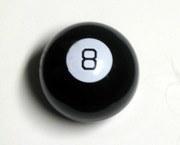
"When will you give us back our papers?"
When they are graded.
"Will you give them back to us at the next class?"
Cannot predict now.
"What did you think of my paper in particular?"
Ask again later.
"Will we get them back before the final?"
All signs point to yes.
"Can I email you multiple times asking you 'what if?' scenarios about my grade and following up with demands for more calculations on your part?"
My reply is no.
"Will you be annoyed if I try to engage you in such an email exchange?"
Most likely.
"Can I ask you for an exact accounting of my grade after class when you are trying to get out of the room before the next class?"
Don't count on it.
"Am I going to pass this class if I don't make it to the final?"
Better not tell you now.
Saturday, December 03, 2011
End of semester syndrome
I think I have end of semester syndrome. Now, I am not a doctor, although I play one for 16 weeks each semester, but here are the symptoms:
Symptoms may also include soundtracks. Here is the soundtrack that accompanies my particular End of Semester Syndrome; yours may vary: http://www.youtube.com/watch?v=4ruFfxlMsbY
Am I the only patient with ESS? What are your symptoms?
- A version of what Ms. Mentor calls October--"exploding head month"--in which although you've been working diligently since August, you realize that you have not accomplished nearly enough, and in your mind that becomes "nothing at all," and your head explodes with the knowledge of what you still have to do.
- Also causing your head to explode: the realization that a whole bunch of deadlines, including MLA presentations, are zooming toward you at the speed of light.
- A twinge of envy: assuming that all your colleagues have accomplished far more than you have in the past semester--have written more, have taught more exciting classes, and have generally outpaced you in every way.
- Happiness that classes will soon be over. No more prep! No more grading! No more writing new assignments! No more figuring out how to teach yet one more brand-new story!
- Sadness that classes will soon be over. You've worked really hard, and you've been with these students for all these weeks, and you're confident that at least some of them have learned something, and it's now all ending. In some way, you know you will miss the familiar routine of going in to teach them, and you will probably miss seeing some of them, too.
- A sinking feeling upon realizing that you now have to get ready to do the whole thing all over again in the spring. You have to think about courses you've never taught before, and dream up assignments, and carry everyone along on your back with your enthusiasm until their enthusiasm for the class catches fire, assuming that it does.
- And did I mention getting ready for the holidays?
Symptoms may also include soundtracks. Here is the soundtrack that accompanies my particular End of Semester Syndrome; yours may vary: http://www.youtube.com/watch?v=4ruFfxlMsbY
Am I the only patient with ESS? What are your symptoms?
Wednesday, November 30, 2011
No outrage, no deep thoughts--just writing
I know it seems all tech tips and web-o-matic writing inspiration (but it does work) around here lately. The thing is, I've been spending time on the Big Project, and to do that, I have to talk to myself.
Talking to myself is taking the form of a research journal or writing journal in which I argue with myself--"Do you want to put in that part? Why not?"--that sort of thing. I write it out, and then I answer my objections, and then eventually I go away and write. A few bullets of this week:
After stuffing one already published piece into this new material I'm writing, I figured out that one chapter really needed to be two. No more stuffing, and a more coherent chapter--or at least I hope so.
My own NaNoWriMo this month was to try to get on 750words.com every day and write something. Sometimes I'd spend all day editing and rewriting, but when evening came, I started itching to get to that clean expanse of the site and type something. If you don't write, you can't edit and make what you wrote better, and even if what came out was repetitious, it worked: the repeated version was usually better and made the editing task easier the next day.
Writing this way made me realize again that writing is discovery. If I was writing in the research journal file or at 750words.com, I kept thinking of things as I wrote. I know--that's an old saw about writing, but it hadn't been working as well lately.
The problem with writing is that academics have to read before they can write: we can't spin webs like a spider unless we have the material already packed away somewhere from someone else's words. Unlike creative writers, we're spiders with a backpack of that kind of material, and once the backpack is empty, we have to fill it back up again no matter how much we might want to write.
I was so committed to this that I graded all the papers, tests, etc. at the very beginning of Thanksgiving break--I even felt like doing it then--so that I wouldn't have to think about grading or classes for the whole break.
This isn't the most exciting post, but I didn't want you think this was becoming Pogue's Posts over here.
Talking to myself is taking the form of a research journal or writing journal in which I argue with myself--"Do you want to put in that part? Why not?"--that sort of thing. I write it out, and then I answer my objections, and then eventually I go away and write. A few bullets of this week:
This isn't the most exciting post, but I didn't want you think this was becoming Pogue's Posts over here.
Thursday, November 24, 2011
Happy Thanksgiving! (and an iMessage tech tip)
Giving thanks for better weather, family on the way, and a reasonably stress-free day so far. Happy Thanksgiving, everyone.
And the tech tip: if you have an iPhone, iPad, etc. and have been trying to use iMessage (free text messaging among Apple products) without success (like thousands of other frustrated users), try adding 8.8.8.8 as a DNS server number.
To do this:
1. Go to Settings -> Wi-Fi -> (name of your network) and click on the blue arrow. When the screen showing the details of your network opens up, look at the line that says DNS.
2. You will see one or more numbers that look like this: 89.87.61 (or whatever). You might have one or more than one sequence of numbers like this.
3. Add a comma to the last number and type in 8.8.8.8 and exit the screen. Example: 123.333.33, 89.87.61, 8.8.8.8
Some sites say to erase the old DNS numbers, but I just added this one (8.8.8.8) to the string that was there, and now iMessage works.
http://appletoolbox.com/2011/10/ios-5-imessage-not-working-%E2%80%93-how-to-fix/
And the tech tip: if you have an iPhone, iPad, etc. and have been trying to use iMessage (free text messaging among Apple products) without success (like thousands of other frustrated users), try adding 8.8.8.8 as a DNS server number.
To do this:
1. Go to Settings -> Wi-Fi -> (name of your network) and click on the blue arrow. When the screen showing the details of your network opens up, look at the line that says DNS.
2. You will see one or more numbers that look like this: 89.87.61 (or whatever). You might have one or more than one sequence of numbers like this.
3. Add a comma to the last number and type in 8.8.8.8 and exit the screen. Example: 123.333.33, 89.87.61, 8.8.8.8
Some sites say to erase the old DNS numbers, but I just added this one (8.8.8.8) to the string that was there, and now iMessage works.
http://appletoolbox.com/2011/10/ios-5-imessage-not-working-%E2%80%93-how-to-fix/
Wednesday, November 23, 2011
Francis Ford Coppola on writing
http://www.npr.org/templates/transcript/transcript.php?storyId=140870590
UNIDENTIFIED MAN #1: The question I wanted to ask is, actually, if you could talk about your writing process, your habit, sort of what's a daily writing day like for you.
COPPOLA: Well, the thing about writing is if you really try, if you do it every day, and you put in your time, you get better. I don't know if there's a - I think with acting that's possible, too, but writing is something that if you really plug away at it, you can get better.
The important thing is: A, choose the time that's good for you. For me, it's early morning because I wake up, and I'm fresh, and I sit in my place. I look out the window, and I have coffee, and no one's gotten up yet or called me or hurt my feelings.
(SOUNDBITE OF LAUGHTER)
COPPOLA: It's very important that your feelings are very, sort of, just stable. You know, you don't want to have a heartache when you're trying to go fly on some adventure of writing. At any rate, it's very important for the young writer to, when you finish the six, seven, eight pages, to turn them over and don't look at them again, because I believe there is a hormone that is injected in the blood of the young writer that makes him hate everything he has just written.
And so just don't read it. And then when you finally have done it over the, you know, 30 days or how many days so that your stack of pages is in the 80s or something, then - and you feel you have it at some completion, then sit down and read it, and you'll find that your reaction will be very different because you will have a little distance.
And you realize that the first 10 pages that you would have just torn up and rewritten, which is to say never go back. If you don't read it, you're not going back and rewriting anything at first, because you don't know yet. And maybe you're just going to cut those 10 pages out, and they're not even going to be in it. So you would have been rewriting something that's not even in the piece.
So give yourself that chance to put together the, you know, 80, 90 pages of a draft and then read it very, at a - you know, in a nice little ceremony, where you're comfortable, and you read it and make good notes on it, what you liked, what touched you, what moved you, what's a possible way, and then you go about on a rewrite.
And I'll rewrite a script a trillion times. So rewriting is just the middle name of writing.
[Note: Coppola wrote the script for Patton, for which he won an Oscar, when he was 24 years old.]
UNIDENTIFIED MAN #1: The question I wanted to ask is, actually, if you could talk about your writing process, your habit, sort of what's a daily writing day like for you.
COPPOLA: Well, the thing about writing is if you really try, if you do it every day, and you put in your time, you get better. I don't know if there's a - I think with acting that's possible, too, but writing is something that if you really plug away at it, you can get better.
The important thing is: A, choose the time that's good for you. For me, it's early morning because I wake up, and I'm fresh, and I sit in my place. I look out the window, and I have coffee, and no one's gotten up yet or called me or hurt my feelings.
(SOUNDBITE OF LAUGHTER)
COPPOLA: It's very important that your feelings are very, sort of, just stable. You know, you don't want to have a heartache when you're trying to go fly on some adventure of writing. At any rate, it's very important for the young writer to, when you finish the six, seven, eight pages, to turn them over and don't look at them again, because I believe there is a hormone that is injected in the blood of the young writer that makes him hate everything he has just written.
And so just don't read it. And then when you finally have done it over the, you know, 30 days or how many days so that your stack of pages is in the 80s or something, then - and you feel you have it at some completion, then sit down and read it, and you'll find that your reaction will be very different because you will have a little distance.
And you realize that the first 10 pages that you would have just torn up and rewritten, which is to say never go back. If you don't read it, you're not going back and rewriting anything at first, because you don't know yet. And maybe you're just going to cut those 10 pages out, and they're not even going to be in it. So you would have been rewriting something that's not even in the piece.
So give yourself that chance to put together the, you know, 80, 90 pages of a draft and then read it very, at a - you know, in a nice little ceremony, where you're comfortable, and you read it and make good notes on it, what you liked, what touched you, what moved you, what's a possible way, and then you go about on a rewrite.
And I'll rewrite a script a trillion times. So rewriting is just the middle name of writing.
[Note: Coppola wrote the script for Patton, for which he won an Oscar, when he was 24 years old.]
Monday, November 21, 2011
A "keep your chin up" post, comfort food edition
If you read the news, it's easy to get discouraged. On the national side of things, this means one party trying to "Kill the Poor" and heap benefits on the rich beyond all reason, with some candidates so venal that they make Richard Nixon look good. On the university side, it means the events at Penn State and the police attack on students at U C Davis. Last year was the 40th anniversary of the shootings at Kent State. I hope we're not headed back in that direction.
So, to keep my chin up, and yours, I'm going to offer you some comfort food: a recipe for cranberry-apple cobbler (or apple brown betty, apple crisp, or apple crumble--name varies regionally).
1. First, get out your apple corer, if you have one (they are fabulous devices) and peel and core about 5-6 reasonably tart apples: McIntosh, Cortland, Honey Crisp, Wealthy, Northern Spy, or Granny Smith. Use all the same kind of apple, though; the cobbler will taste better. If you use sweeter varieties than these,
 use some lemon juice put the juice of 1/2 to 1 lemon in the recipe, depending on the sweetness of the apples.
Cut the cored and sliced apples in quarters so that the slices are small.
2. Preheat the oven to about 400 degrees and get out a pan, the size you'd use for brownies or a one-layer cake--about 8 x 11." Butter the pan.
3. Put the apples in the pan along with about a cup of fresh cranberries. Combine 1 c. sugar and 1 tsp. cinnamon in a bowl and pour it over the apples and cranberries. Toss this together with the fruit so everything is coated with the cinnamon-sugar mixture.
4. In another bowl, cut together with a pastry cutter or knives: 1 stick (i.e., 1/2 cup) of butter, 2/3 c. brown sugar, 2/3 c. rolled oats, 1/3 c. flour.
5. Spread this crumble mixture over the top of the apples and bake for about 35 minutes, until the fruit bubbles along the sides and the top is browned.
This is good served warm with ice cream and also just by itself.
There, don't you feel better now? It sure helped me.
So, to keep my chin up, and yours, I'm going to offer you some comfort food: a recipe for cranberry-apple cobbler (or apple brown betty, apple crisp, or apple crumble--name varies regionally).
1. First, get out your apple corer,
 if you have one (they are fabulous devices) and peel and core about 5-6 reasonably tart apples: McIntosh, Cortland, Honey Crisp, Wealthy, Northern Spy, or Granny Smith. Use all the same kind of apple, though; the cobbler will taste better. If you use sweeter varieties than these,
 Cut the cored and sliced apples in quarters so that the slices are small.
2. Preheat the oven to about 400 degrees and get out a pan, the size you'd use for brownies or a one-layer cake--about 8 x 11." Butter the pan.
3. Put the apples in the pan along with about a cup of fresh cranberries. Combine 1 c. sugar and 1 tsp. cinnamon in a bowl and pour it over the apples and cranberries. Toss this together with the fruit so everything is coated with the cinnamon-sugar mixture.
4. In another bowl, cut together with a pastry cutter or knives: 1 stick (i.e., 1/2 cup) of butter, 2/3 c. brown sugar, 2/3 c. rolled oats, 1/3 c. flour.
5. Spread this crumble mixture over the top of the apples and bake for about 35 minutes, until the fruit bubbles along the sides and the top is browned.
This is good served warm with ice cream and also just by itself.
There, don't you feel better now? It sure helped me.
Subscribe to:
Posts (Atom)