Friday, June 03, 2022

Service Tennis, or how to put that ball right back across the net

 As new academics, we're taught (or do we just internalize?) the need to make things right.

Or maybe this: as women who are new academics, we're taught (or do we internalize?) the need to make things right. 

  • Draft of some report or document not right? Let me get right on that and rewrite it so that it sparkles, thinking through and addressing its conceptual problems as I do so.
  • Committee work? Sure, I can volunteer.
  • Take notes? No problem.
  • Write a book review? Let me at it.
  • Review an article or book manuscript? Sure, why not? 

But possibly inspired by some of the feelings that the article Maya recommended in the comments of the last post and also by rereading a few of my self-directed come to Jesus talks about doing too much service, this year has brought a change.

  • Draft of some report or document not right? Well, it's a collective draft. I fix what I can't live with and figure "many hands make light work" for correcting the rest. Could I make it better by spending more hours on it? Yes. Should I make it better by spending more hours on it? That's the real question.
  • Committee work? Is this a committee that has some actual use for what I bring to the table, or am I warming a chair? If the latter, bye.
  • Take notes? Yes, if no one else steps up. I've done enough volunteering to do this for an academic lifetime. Let's start acting as if this takes a village, which it does, and the same people don't have to do this always.
  • Write a book review? Never again, honestly. Marley's ghost is still haunting me, and this is probably the last one I will volunteer to do. I'd rather recommend a more junior scholar who can benefit from the experience, and it's better for them, too.
    • Also, what's with the new trend of sending ebooks or a link where you have to sign up for a site, etc., to get the book on a time-limited basis? Ninety percent of the value to you as a scholar doing a book review is that you get to read and have a copy of the actual book. The last thing I need is more hours of screen reading where it's tricky to mark up the copy with points you'd like to make.
  • Review an article or book manuscript? It depends. Is this helpful in terms of alerting me to new trends in research as well as being a service to the profession? A few years ago, an insidious voice started inserting itself whenever I reviewed something. You could be writing right now, it would say. You only have X number of productive hours in a day. Is this how you want to spend your time? This benefits others, which is laudable. Does it benefit you, as well? Isn't that also a laudable goal? 

I thought of this today when I received back a draft of something I'd sent to a committee, of which the point person mentioned that some changes would be good and that the other point person was on vacation. In the old days--and this was my first impulse--I'd have spent time making the changes and then sent it back.

Today, I lobbed it right back across the net and said "send it back to me once you've made the changes. Have a great day!"

 If you think of all this as your responsibility, it sounds selfish.

If you think of it as a collaborative game, you can hit that ball right back across the net and see it as a win for everyone.


Edited to add: see “Tips to Reclaim Your Time” by Leslie K. Wang over at IHE. https://www.insidehighered.com/blogs/university-venus/tips-reclaim-your-time


Monday, May 16, 2022

NYT: "My College Students are Not Okay" by Jonathan Malesic

 First, here's the article: https://www.nytimes.com/2022/05/13/opinion/college-university-remote-pandemic.html

 The TL;dr on this is that students are tired--exhausted, even--and disengaged. When they go to class, they won't speak up, as if they're watching you on Zoom. 

Based on an N of 1 (me) over the past two years, I agree on some things Malesic's saying, but not all.  

  • First of all, we need to separate out Zoom classes, in-person classes, and designed-to-be-online and asynchronous classes. These are different animals. I only taught a few Zoom classes, and they seemed to work pretty well. 
  • The in-person classes? I guess I didn't post a lot about them, but honestly, they were great. We wore masks but it worked fine (worked a treat, as the Brits say). Was it their energy, being glad to be back, that made the energy in that classroom? Was it partly me (ditto)? Was it the approximately 1.5 times the effort that I put into those classes? More effort doesn't always result in a better class experience (shudders in memories of classes past), but maybe this time it helped?
  • Online classes: these take 2 x the effort of an in-person class, and this semester especially I'd estimate that my time was spent about 80% on teaching and the remaining 10% each on research and service. This isn't ideal and is definitely not what my contract calls for, but it felt hugely necessary. Some thoughts: 
    • In an in-person class, you know how sometimes you feel as though you are emotionally lifting them, encouraging them to speak, etc. and are wiped out at the end of the class, and at other times you might be a little tired or whatever but their energy helps you? This semester, I poured so much energy and time into teaching that it wore me out--but then they started giving back, even though it was an online class--more & better responses, coming to office hours (via Zoom), etc. 
    • And they deserve the credit for coming through so well--they really do. To borrow a piece from Bardiac's post, they really did exceed expectations, by and large; those weren't "well, it's COVID so it's an A" grades at all. They know what the expectations for writing are, and some of them complain mightily about having to write in complete sentences, etc., at first. It's a kind of "Do you know who I am?" attitude that sometimes afflicts seniors and majors who claim they haven't been called to account for their writing before, but then they learn and it's a pleasure to see the change for the better.
    • While it's doubtless true, as some of Malesic's interviewees say, that you can't teach some courses online (hello, lab science!), I don't teach lab science and would say that some things can be taught & discussed just fine online. I'd say in any given class about 5-10% were "disengaged" in Malesic's sense.
    • I just looked at course evals, and the students seem to have gotten a lot out of the classes, so there's that. 

But yes, to Malesic's point: more requests for extensions than usual, etc. do point to their being exhausted and burned out. 

And so are we, aren't we?


Monday, May 09, 2022

The teacher I want to be

 First of all, I do love teaching. 

Second, I believe in flexibility, and my syllabus has all kinds of alternative assignments, escape clauses, and get out of jail free extensions built into it--all stated right up front, with no need to have class privilege to know that they're available. I talk about them. They're in the syllabus. I email students about them, if they seem not to know.

For a lot of years--decades, even--this has been enough. If a student tries, it's hard not to succeed if they put any effort at all into it, because there's always another way. They may not get the grade that they think their writing deserves, because they insist that I'm the only teacher who's ever told them about picayune details like writing in complete sentences; however, they usually come around once we've met for a few times and gone over their papers. But in my classes, there other ways to succeed.

Yet it's been a tough semester for us all. Contra academic conferences, which are so over COVID, my students are getting sick regularly despite being vaxxed, and I've made a lot of allowances for that. I've responded to emails on weekends. I've been available. I've given feedback. I've met with them. I've notified them through the course space if they didn't turn in papers (online classes--you kind of have to do this). I have put in more hours on teaching this semester than in any recent semester I can remember.

And now, a minute and a half before grades are due, students who haven't checked into the course space for literally months want to turn in assignments that they had ignored for said months. Or they've skipped a bunch of assignments but are emailing "I need an A." Or they start rules-lawyering over some minor point, which is hard to do given the really specific details in the syllabus. Or “I have a lot of work in my other [implied: more important] classes and am handing this in late.”

And with all the "take it easy on your students; COVID, etc." directives being issued, it's hard to say no without seeming like a monster.

It's probably for this reason that I'm finding this really dispiriting, even though I know I shouldn't take it personally. It's like some kind of fall from grace, or a fall from the kind of teacher I thought I was and want to be. This didn't happen in the Before Times, or happen as much, and it didn't bother me when it did because I could just point to the numbers. 

I don't want to be that tough old rounder who rejoices in saying no, but it's getting harder to keep that store of goodwill and enthusiasm flowing and to be the kind of teacher I want to be.


Monday, April 18, 2022

How long is this semester? Groundhog Day long, that's what.

  • Like a good portion of the rest of the country, Northern Clime is getting snow. In April. Every day. Snow. What is it Bill Murray says? "It's going to be cold, and it's going to be gray, and it's going to last for the rest of your life." Yeah, what he said. 
  • Tulips are coming up, but they're saying "nuh-uh, not going to bloom when we're just going to freeze to death." 
  • I am playing whack-a-mole with our LMS. When I see that someone's turned in one of the minor full-credit assignments, I go in and give it comments immediately, just so I can see it disappear from the ever-lengthening sidebar list of things to grade. 
  • I gave a conference paper (the conference had sensibly moved online), and rediscovered (1) how stressful it is and (2) the feeling of giddy elation when it's over. It's the old story of hitting yourself in the head: it feels so good when it stops. 
  • The mask thing is going pretty well, though. Most places I go--that is, the grocery store--there's a good third of the people who are masked. If you think about it, how much attention did we pay to people's faces before the pandemic? Not a lot, and it's the same now; I barely look at them and vice versa. Nobody's said anything to me about it, and everyone seems pretty chill. 
  • I'm ready if someone does say something, though. Here's my projected response: "Merry Christmas!" Cheerful enough to be inoffensive, and strange enough to make them give me a wide berth in case I am unhinged, and, in this part of the country, armed. 
  • It's hard to get back to writing and thinking, although the conference paper proved that I could do it, so I guess it's time to get back to it. 
  • Updated to add: a Florida judge just voided the mask mandate on planes for bonkers reasons ("masks don't do anything"). This is bad for so many reasons (children, immunocompromised people, and, oh, by the way, the rest of us who don't want to get any flavor of COVID). From an academic perspective, people on Twitter are now fretting about flying to conferences. Not to harp on the same old idea, but you know how you can't get COVID if you're at a conference? Through a Zoom screen. We are all supposed to be throwing praise parades for the in-person conferences, but this is a risk that just got riskier, not that anyone is paying attention.
  • Another update: “who needs a mask? Covid is over completely, so definitely not me” from Megan McArdle (https://notofgeneralinterest.blogspot.com/search?q=Megan+mcardle ) conservative columnist and author of helpful advice like “if you’re not rich, perhaps you should consult your broker” and “old people get poor and die—get over it” https://www.washingtonpost.com/opinions/2022/04/19/mask-mandate-flights-federal-judge-cdc-this-is-the-right-moment/?itid=hp_opinions

Friday, April 08, 2022

Random Bullets of April


  •  COVID, now with new and improved Omicron 2.0, is still flourishing here and elsewhere. British Airways had their flight crews take off masks, and oh, look, their COVID rates rose.  I'm still wearing a mask, and at least a third of the people I see at the grocery store are, too. 
  • I'm sure you all saw how UCLA posted a job offering with all the usual requirements, including 5 references, for a professorship for which you would be paid . . . nothing. This was in the sciences, and it probably had something to do with teaching for glory--er, faculty affiliation--when you already make lots of $ on grants, but still. Are we there yet at the English Department of the Future
  •  Speaking of fancy schools doing dubious things, if you haven't read Rachel Aviv's New Yorker investigation of how U Penn treated one of its students, Mackenzie Fierceton,  go read it; it's excellent. This follows a Chronicle of Higher Ed account that takes a skeptical view of her story; Aviv's account has a more complete and sympathetic version.
  • Twitter is doing its usual blend of genuinely useful information and theory and contemporary culture fight-fests over stuff where I have no idea what they're talking about. 
  • In other news, I now believe that people should be required to get signed permission slips from all their neighbors before they put up outdoor wind chimes. 
  • Friday night, and still grading--how about you? It's that time of year when grading is kind of like bailing out a leaky rowboat: just when you think you've got one hole plugged up and the water in the boat goes down, another one springs up. 

Now, I'm not complaining about the fact of having to grade. They're our students, and they deserve to have comments. I've never learned the trick of having them learn to love grades that are simply checks on a rubric, even though I've caved in and made some beautiful rubrics this semester. The comments help them, if they read them, and that's something I can't control. 

It's the time  that grading takes. I just don't understand how it can take so much time, even with all my little timer tricks. It just . . . does. 


Monday, March 21, 2022

Random bullets of "March? Already?"

  •  

    First, some writing house inspiration, courtesy of Wendell "I don't need a computer" Berry: "Hidden in the woods on a slope above the Kentucky River, just south of the Ohio border, is a twelve-by-sixteen-foot cabin with a long front porch.. . .The camp has no plumbing or electricity. Half a dozen well-sharpened pencils were lined up on the worktable, alongside small stacks of paper. On top of one stack was a note Berry had made, and crossed out, about Marianne Moore’s poem “What Are Years?” Above a small safe, curling photographs were taped to a wall: Wallace Stegner, Ernest Gaines, Donald Hall and Jane Kenyon, Thomas Merton." My writing house also is 12 x 16, so Wendell and I are obviously destined to be famous authors together. 
  • So much teaching. So much grading. So much time spent on both.  I want to channel Winston Churchill here: "Never in the history of mankind has so much time been spent by one person in the attempt to create a resource appreciated by so few." Written lectures, video lectures, responding to their posts, grading: I thought I had made it up that online teaching takes 2x as much work as in-person, but this year, on an N of 1 (me), I can confirm that it does.
  •  In an extremely ill-advised moment, even after vowing never to do another one, I said I would do a book review last year. The book is good, but very, very, very long. I read it last summer and never wrote it up, with the result that I now have to read it again to write the review. Spouse says I have been dragging it around with me for a year like Marley's chains in "A Christmas Carol," and he's not wrong. 
  • Now that everything's going back to maskless in-person events (even with Omicron 2.0 peeking around the corner), it's back to the irritating calculus of whether to burn an entire day traveling to campus and getting no work done to support a colleague doing a presentation. There were two presentations today I would have happily attended if they were on Zoom. They were in person, and I had a lot of work to do (travel burns the whole day), so I missed both of them. 
  • Gwinne has an interesting post about the amount of work we do. I'd break that down even further into categories:
    • Work that we are paid to do that's interesting but takes far too much time to do it right (teaching). 
    • Work that's invisible and that no one cares about unless it doesn't get done (service, administration).
    • Work that we want to do in terms of research but that gets pushed out by #1 & #2.
    • Work that we at some point agreed to do and that we can't seem get done, like Marley's chains up there. 
    • Work that we are harried into on someone else's schedule because however much lip service they pay to things being collaborative, etc., the only schedule they actually pay attention to is their own. 
  • I'm still wearing a mask to the grocery store & everything, because why not? No one seems to mind.
 And with that I will close for now, leaving you with these words: "“I wear the chain I forged in life  . . . I made it link by link, and yard by yard; I girded it on of my own free will, and of my own free will I wore it.”

Saturday, January 22, 2022

A Writing Inspiration Twofer: George Saunders's Writing Practice AND his Writing House

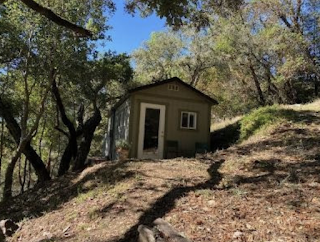
 I was recently scrolling through Shedworking (https://www.shedworking.co.uk/), a UK* site for hopes and dreams about writing houses, when I saw this two-parter about the novelist, short-story writer, and critic George Saunders (Lincoln in the Bardo is his award-winning novel).


Here, from Shedworking, is a picture of his writing house in California. 

(Insert pause here while you sigh with delight.)

And here, from the New York Times* via Shedworking, is a bit about his writing practice:

"Saunders writes in a shed across the driveway from his house, where we sat for a couple hours one morning while his two yellow labs nosed around outside the door. There’s the desk and a sofa and a table stacked with books that he has been researching for his next project."

And this from The Guardian: 

"His first newsletter includes a photograph of his solitary writing shed in the woods behind the house in Corralitos. His wife, Paula, bought it for him a few years ago, and it’s a writer’s dream. No fences or distant rooftops. Just the shed surrounded by trees and the shadows of trees. Writers’ rooms are usually reclusive. But Saunders is using his to host a writing community. Why does he care? “I suppose one of the things that a person worries about along the way is, ‘Does this really matter?’”

  “To go up in that shed every day was so helpful.” It was, he says, a way of saying: “‘I can’t control the world.’"

And finally, from his new substack at https://georgesaunders.substack.com/p/welcome-to-story-club, which sounds very much worth the $6 a month:  

"I’d come flying/stumbling down at the end of the day from a little writing shed I have up on the hillside in Corralitos, California, feeling, not that I’d “taken a break from” the current difficulties, but that I’d, well, girded up my loins for a deeper, less fearful engagement with the world."  

I am tempted to join the Story Club substack, not only for the pleasure of learning about writing short stories from a contemporary master at the top of his game but also in hopes that we will see interiors of the writing house.

Digression 1:  The Brits take their garden sheds/writing houses very seriously and even have an award for them.

Digression 2: From the New York Times piece, I learned that Saunders has the same guilty pleasure that I do--reading Vanity Fair on a plane. Famous genius writers and obscure bloggers--they're so alike!


Saturday, January 08, 2022

Random Bullets of MLA 2022

 It's become a (semi? quasi?) annual tradition to post from MLA, and although I skipped last year, here's what it looks like in this Year of Our Covid 2022.

  • MLA was not virtual for a long time, but then the MLA gods started seeing the same astronomical COVID omicron spikes as the rest of us and relented: in-person panels could go virtual if they announced this by December XX. When my panel chair announced this and asked us our opinion, it took me less than 4 minutes to blast a reply-all saying "Please, let's do virtual, I beg of you, because there is a major pandemic" or words to that effect. We went virtual, and hooray! 
  • I have been grateful about this every single day, and seeing 1700 to 2500 flights a day canceled because of terrible weather has increased my gratitude exponentially. I've spent enough time sitting on floors or scrabbling for outlets or eating stale sandwiches in SLC or MSP or DTW, or sitting on hold with airlines, in the best of times and felt I could skip that level of misery and anxiety this year once we went virtual.
  • Unofficially, I've heard that about 80% of the panels are now virtual. Some are in person, and some have chosen to defer their panels until next year.
  • What's the experience like? Fantastic! I'm attending lots of sessions, hearing smart people talk about interesting research, and really enjoying it. It's shaking up my brain, in a good way, and giving me lots to think about--and isn't that the point? And I'm buying more panelists' books now that I don't have to spend the money on travel--which Northern Clime doesn't reimburse.
  • Better still, since we're all used to Zoom now, we know enough to mute sound and video, to do the little applause hands at the end, to share screen, and all the rest. And with Zoom, I can get up and pace around the room rather than sitting in an overheated conference room pinching myself to stay awake; it's much easier to listen, learn, and take notes when you have freedom of movement. 
  • How can I say this? People are . . . better speakers, somehow, with Zoom. Everyone can hear the speaker--there's no harrumphing about being too good to need the microphone--and the transitions between speakers are really smooth, with no "my PowerPoint won't load" drama during which the audience kills time. And people are really prepared to keep within the time limits. Conversation is lively in the Q & A, and the rambling and posturing that sometimes mars sessions is kept to a minimum.
  • There's always a bit of performative mourning about not being in person, not being able to spill out into the hall and continue the conversation there. Yet those conversations aren't always as inclusive as the conversations in the sessions, since only a few would be invited to join those hallway conversations. You can find community at a conference, they say, but there's also the isolation of being excluded from a group, of eating that sad, overpriced room service salad at the end of the day if you couldn't find dinner companions. At home, that clubbiness isn't being played out before your eyes. 
  • At the end of the conference (tomorrow), there won't be a solid day of travel with the inevitable cold that I always catch; in 2022, that would come with added excitement--flight delays! omicron! swords and fisticuffs on planes!--that I can also do without. Instead, I can take a deep breath and get ready for spring semester.

We'll go back to in-person conferences, surely, so this little golden age of virtual conference attendance won't last. But for now, I'll enjoy virtual MLA to the fullest and try to look downcast as everyone laments the loss of the in-person version. 

Edited to add: 

  • There seems to be less session-hopping on Zoom, and people are on time—but if you’re a couple minutes late, you can still get into the Zoom room without fuss and embarrassment. There’s no knocking on a locked door, or turning up at a session only to find the room full so you can’t get in to hear the speaker. This happens especially at celebrity panels—there was an Adrienne Rich panel at which she appeared years ago where there was an impressive overflow into the hall and no way to hear her—but it happens at other ones, too.
  • I do like in-person conferences and being able to talk to people, go out to dinner, see the book exhibit, etc., but virtual is just fine, too.

Previous MLA posts: 

Other MLA Conference Posts:

Wednesday, December 22, 2021

Random bullets of the "Is COVID over yet?" semester

  • Answer: Ha! not even close to over. On the other hand, we can now get vaxxed AND boosted AND have good masks available, though few or no rapid tests. 
  • Also good: as Omicron spikes & Washington, D. C., declares a state of COVID emergency or whatever, MLA is allowing previously in-person panels to be remote. Most of us are grateful.
  • But remember Miranda Priestly in The Devil Wears Prada, saying "Please--it's just drizzling" as a hurricane raged outside and she demanded a helicopter to take her back to NYC or heads would roll because how dare a natural event keep her from something to which she was entitled? Yeah, some of the academics on Twitter who were all "Pandemic? what pandemic?" are disgruntled, and no, I don't care. It's a pandemic. People are dying. Hospitals are full.  Even the NHL canceled, for God's sake. MLA powers that be--Paula Krebs and the rest--if you're out there, thank you!
  • Teaching this semester (in person and online) was fine. It was really hard work but really rewarding, if that makes sense. I know they learned things, and I think they had fun doing it. 
  • Writing: not much to report in that sector. I'd say I spent about 80% of my time on teaching this semester, no lie. But I'm getting glimmerings of wanting to work on a new project and have ordered books.

Sunday, October 31, 2021

RBOC and some writing inspiration

  •  First, some writing inspiration from Paul McCartney in The New Yorker: "As McCartney recalls, “George would say, ‘Be here at ten, tune up, have a cup of tea.’ At ten-thirty you’d start.” Two songs were recorded by lunch, and often two more afterward. “Once you get into that little routine, it’s hard, but then you enjoy it. It’s a very good way to work. Because suddenly at the end of every day you’ve got four songs.” This puts Sir Paul in the "write every day" camp, and I am here for it. At the end of the day you've got four songs; at the end of the pomodoro, you've at least got more words than you did at the beginning.
  • More writing inspiration, but very vague, I'm afraid: a writer recently posted that he gets up really early to write not despite his being too tired but BECAUSE of it. The fatigue, etc. helps him to stop dancing around and actually get down to writing, because it turns off his inner editor. I saw this and shouted "this is me!" to the cats, except that for me 9 p.m. is the witching hour when the inhibitions put out a "gone to lunch" sign and I can settle into writing. I am still doggedly trying to write in the morning because at 9 p.m. on a teaching day, I am really too tired for any work, but morning writing is never going to be the same as those quiet evening hours.
  • Seeing pictures of modern writing houses, I'm struck by how they seem to come in two styles: stuffed to the gills with mementos, children's pictures, artwork, and various cozy knicknacks; and bare in a pure minimalist style, with just fancy chairs, a laptop, a couple of artbooks, and some inspirational "live laugh love" thingy on the wall, with nary a functional file cabinet in sight. The point is that they have a definite aesthetic. Mine does not have an aesthetic, unless "office for reading and writing" is an aesthetic. To my mind it's the most beautiful (because it's roomy and mine and I love it), but I was ridiculously fretting about its not making A Coherent Aesthetic Statement and that I was somehow shortchanging it because I wasn't making it beautiful enough. Spouse wisely said "it's for your work, not theirs. Work is your aesthetic."
  • My double life of pretending regret about not going to conferences and that there is no COVID or that travel is not a challenge, like the rest of the academic conference world, is making me a bit irritable privately, though I'm still maintaining the public facade. 
  • Was Halloween always such a big deal? When I was a kid, we dressed up and went trick-or-treating on October 31, usually with our parents, but they didn't dress up and the houses were just regular houses, not decorated. Around here everything is Halloween for all of October, and a lot of people decorate and dress up. Was it always this way? Or do we just want more holidays now (not a bad thing)? 

Friday, October 29, 2021

If a crazy donor put up $200M to build a windowless dorm, with tiny rooms, would your university do it?


 UCSB says, "heck, yes!" https://www.independent.com/2021/10/28/architect-resigns-in-protest-over-ucsb-mega-dorm/

Short version: "97-year-old billionaire-investor turned amateur-architect Charles Munger, who donated $200 million toward the project with the condition that his blueprints be followed exactly."

These include the following:

  •  2 exits for a building to hold 4500 students.
  • 1 bathroom per 8 rooms, which is bad for all kinds of reasons I leave to your imagination.
  • Did I mention NO WINDOWS? In a place with a view of the ocean? 
  • And that he's paying 200M but UCSB will shell out 1.5 billion to create & maintain this monstrosity?

When he's not reaching into the past for all kinds of inhumane social experiments for his inspiration, Munger apparently makes this offer to various campuses, and some have accepted (Michigan? Not clear.).

 As is unfortunately typical of some university governance processes when money is involved, this was apparently rammed through without any discussion. 

The consulting architect, Dennis McFadden, clearly a man of principle, has quit, because “in the nearly fifteen years I served as a consulting architect to the DRC, no project was brought before the committee that is larger, more transformational, and potentially more destructive to the campus as a place than Munger Hall.” 

Let's recap: take students stressed out by a year of COVID. Warehouse them like lab rats and force them to interact. Provide not enough bathrooms. And fire drills in that place (how did this ever pass a fire code?) will be a real treat, with 4500 students streaming out the two doors at 2 a.m., unless prank fire-alarm pulling has vastly changed over the decades. 

Wasn't there a lab rat experiment that proved what a bad idea cramming people into a windowless space could be?

And when sleep-deprived students show up in our classes, guess who will get to bear the secondary consequences?

 Nothing could go wrong here, nothing at all.  

P. S. With its steady drumbeat of "no offices for professors is the great future that awaits us all," I'm surprised that CHE isn't cheerleading this effort.

Saturday, October 09, 2021

Bad Art Friend: the blue/gold dress of 2021

You've doubtless seen this one: Robert Kolker's "Who is the Bad Art Friend?" in the NYTimes Magazine. 

Here's the short version:

1. A lightly-published writer (Dawn Dorland) donates a kidney, seeks support (praise?) for doing so by setting up a Facebook private group and inviting writers and others to it, including the more-famous Sonya Larson. She posts an open hypothetical letter to the kidney recipient explaining her reasons. 

2. Larson lurks on the group but doesn't post. Dorland looks at her stats, sees this, and reaches out to Larson by email (who does that?).

3. Larson writes a story, "The Kindest," in which a deluded white savior type donates a kidney to Chuntao, who is--unimpressed? 

In the earliest version of the story, Larson, in order to mock the white savior more effectively, uses part of Dorland's letter word for word, telling her group of writer friends, the Chunky Monkeys, that it was too good not to repeat. Later, she changes it slightly. 

Dorland pursues Larson: those are my words. Larson feels pursued but doubles down: oh, you own all the words and kidney situations, do you? Tells her friends, who along with Larson have been mocking the needy Dorland all along. Lies to Dorland.  Lawsuits ensue. 

The reactions, from Celeste Ng and others on Twitter and in the NY Times comments, have been fascinating. 

1. Writers: Dorland was never our friend; we just liked to mock her. Anyway, she was annoying, and persisting in claiming her words is borderline harassment. She was not part of Our Group, the Chunky Monkey in-crowd. We are Creatives and taking those words and Dorland's life situation was creative license--deal with it. And anyway, Dorland shouldn't write about her kidney donation, because she's begging for praise and it destroys the purity of her gift. Only we should write about it. 

Honestly, this is the take from most of the writers I follow on Twitter, all of whom say "it's clear who the bad guy is here--Dorland, duh."  

The Atlantic has an essay by Elizabeth Bruenig saying "get a load of that awful Dawn Dorland" with no hint of the stolen words backstory, which gives me reason 1,000 why I'm glad I am no longer a subscriber after decades of paying money to The Atlantic. 

2. People who aren't writers: "Wasn't that mean, though, to take her words and gang up on her? Why are you mocking her for being needy and for, excuse me, giving a kidney?" 

My take, as a lowly English professor:

Leaving aside everything else: Isn't the appropriation of someone else's words without attribution what we call . . . plagiarism? And call out in student papers?

I get why Larson would attack and get her group to back her with a lot of excuses. I've seen it whenever I've confronted a student about plagiarism, even when I'm sitting there with a word-for-word comparison. They get defensive and angry. 

It doesn't change the facts. I still report it to Academic Integrity or whatever the university unit about that is calling itself this year. 

Would I ever say this, though, on Twitter? Absolutely not.  I went through middle school, and believe me, I knew Mean Girls.  I also know that the Mean Girl syndrome doesn't stop there. 

Larson said that she wanted "The Kindest" to be a blue/gold dress story, where the woman with the white savior complex and the woman who got the kidney were both wrong and right, depending on your subject position. 

But Kolker's reporting, it seems to me, is providing the real test.

What are your thoughts? 

Updated to add: 

Here's Olivia Craighead at Gawker: sure, there was 'light plagiarism' but ewww Dorland. Dorland pitched her story to the NYTimes, which we can all agree was the REAL crime.

Buzzfeed: #teamSonya https://www.buzzfeed.com/daily/new-york-times-bad-art-friend-kidney-donation-dawn-dorland

Last update: Summer Brennan lays out the whole case, with screenshots, here: https://summerbrennan.substack.com/p/bad-discourse-friend-the-unraveling


Wednesday, September 29, 2021

The two-headed conference Cassandra and other stories

 I know I wrote about this last time, but about conferences: can we just not?

Conference 1. Recently, for a conference in a month or two, I had to tell people that despite being vaxxed I was just not comfortable sitting in a crowded plane/crowded airport/crowded hotel rooms/crowded restaurants just now. Virtual was an option, so why on earth wouldn't we choose that? I didn't mention the $2000 (I added it up) out of pocket cost of going to the conference because there is no departmental travel money.

They looked at me as if I had grown two heads.  Really? Why do virtual when we could be in person and see everyone?

Conference 2. Then, for another conference in a deep red state that's unvaxxed and proud, I decided not to submit a proposal. It would have been another $2000 out of pocket, incidentally, but that wasn't the main reason.

People I talked to: why on earth not? Don't you want to go? Everyone will be there!

Because we're in the midst of a pandemic, that's why. I didn't say this, because again: I didn't need to be looked at like I'd grown two heads.

Conference 3: With plenty of time to spare, I told the organizers of a small conference that I always attend that I wasn't going to be there for a roundtable. No problem, they said, but again: really, you're not going?

I don't know about where you are, but here, hospitals are full. People can't get needed surgery. Oh, and also: people are getting sick and some will never get well. Children under 12 can't get vaxxed yet. There's a large contingent of people doing their "research" about lizard people and microchips and whatever other ridiculous nonsense the right wing is cooking up and deciding not to get the vaccine. They're storming school board meetings and banging on doors and threatening teachers in addition to being general maskholes and behaving badly in public places.

Oh, wait--according to the Washington Post and the NY Times, this is everywhere in the U. S. 

So both of my two heads and I will stay home from at least these conferences for a while. I will hope that everyone is safe from the virus while traveling and that, unlike Cassandra, who predicted the future and wasn't believed, I will be wrong and that COVID will spare everyone.  And unless I have to, I'll keep my mouth shut, because I don't want to be judged for not believing in the COVID-free conference bubble that the rest of academe seems to think exists.

**

Other stories:

  • Teaching is going really well. It's great being with students again, and teaching and learning with all of us fully masked is not a problem at all. It was even okay that one day when (1) I forgot my whiteboard markers and handouts; (2) the overhead camera declined to work;  and (3) the computer didn't work, either.
  • I am spending so much time on teaching that very little else is getting done. All the work on teaching I do now is work I won't have to do in the future, although right now there aren't hours enough in the day. Everything seems to take twice as long as it used to. I've started keeping track even more closely in my little black book: how many hours to write up this lesson/lecture, this quiz, answer these emails, grade these papers.
  • A lot of the time is going into developing rubrics, which our LMS seems to like if not require; also, some students have written to me looking for them. As you know, I have had mixed--make that very little--success with rubrics, but I'm apparently willing to put 20+ hours into it to try to make it work. 
  • Is anyone else exhausted this fall?
  • On the plus side, our sweet elderly cat will stop braying at the door if we feed her canned food 3 times a day, so that is a win. 


Sunday, August 15, 2021

Ready for conference travel? At IHE, Joshua Kim says "not so much."

 Over at IHE, Joshua Kim asks whether  we're ready to go back to conference travel and whether we have any conference travel planned for this year.

Answering second part first: Yes, I do have conference travel planned.

Answering first part second: No, Joshua. I am so not ready. 

Why? Let me count the reasons.

1. Judging by what I've read and saw when I was on Twitter, travel is a nightmare right now. Expensive flights. Canceled flights. Hours on the phone to rebook the flights. No rental cars. Filthy rental cars that break down. This is all quite apart from the necessity of being Niles Crane and wiping down surfaces, not eating so you won't have to remove your mask--and a significantly higher risk of people acting out in the air. 

2. Somewhat related: all kinds of systems and protocols are changing all the time right now, especially internationally. There's a mask mandate. No, there isn't. You have to quarantine. Well, maybe not, but you have to test within 24 hours.  It's natural that advice constantly changes, and it's right that we get the best information, but planning isn't easy. And--bonus--when you get there, you will not be seeing people's faces, because they will have masks on.

3. Also somewhat related: Did I mention that there's this pesky global pandemic still going on? One with a hugely infectious Delta variant that's getting worse every week? And that kids under 12 can't be vaccinated yet? And that if you're vaccinated you might not get as sick, but you still might get sick? Am I the only one who knows this? 

It's like the options in the "Spam, spam, & spam" Monty Python skit, where they're give options like "spam, spam, eggs, and spam" and "eggs, spam, and eggs" but there is no option without spam, just one "that's not got much spam in it." We don't have a virus-free option, just one that, if we're vaccinated, has "not got much spam (virus) in it."

4. It's expensive. I pay my own work travel, most of the time, since our travel allowance for the year is never enough; sometimes it covers most of one conference, but most of the time not. Figure $1500 minimum for a conference, between airfare, hotels, conference fees, cabs/Lyft/Uber, meals; it all adds up. Those thousands of dollars winging across the country to present a paper? It's mostly out of pocket, from my laughably titled vacation fund.

5. With his authority, Kim says "Zoom conferences are the worst." With my authority, I say, "No they aren't." If the purpose is to schmooze with others and go out to dinner, then no, Zoom can't do it all. If the purpose is lively intellectual conversation, then yes, it can. 

But apart from "Zoom conferences are terrible," I'm with Joshua Kim on this one. 

How about you? 


Friday, August 13, 2021

5-minute post 8/13/21

 Inspired by Dame Eleanor and xykademiqz, a 5-minute post.

  •  Let's see--what's positive? My campus wants people to get vaccinated. I bought more masks and am practicing my death glare for people not wearing them on campus. 
  • Once in a while the temperature goes below 90-100 degrees, although the air quality index hovers somewhere between very unhealthy and "Judas Priest, don't go out there if you don't want to kill your lungs." I really miss walking, not to mention breathable air.
  • I've stayed off Twitter for the week, and in addition to shedding its negativity, I've found more time to read actual books and even some contemporary short stories. 
  • My remaining sweet cat is trying to make up for the absence of her sister and brother by being affectionate and demanding enough for three cats. I also have an elderly cat, whom I love but who spends 16 hours a day within three feet on either side of the back door, either braying to go out or braying to come in. 
  • I am successfully keeping my mouth shut when people say "hooray, no more Zoom teaching!" because that's not our option this year and I want to be perceived as being on "Team In-Person."
  • No Zoom got me thinking about this: did your campus have you designate a teacher who could take over your classes last year? Basically a pedagogical next-of-kin in case, as they delicately put it,  you were "unable to complete the course for some reason"? We had to do this last year, but nobody's asked about it so far this year. 


Friday, August 06, 2021

How YOU doin'? A follow-up to the previous post, I guess.

Seriously, Joey Tribbiani (Friends) & those associations aside, how are you doing? 

 I ask because we're supposed to be all over this COVID drama, right? Right? 

And we're supposed to soldier on, Delta variant be damned. 

Teach in masks, because we're all hands on deck. Back to school meetings? In person, with a Zoom option if you're still harboring some illusions that there's still a pandemic.

People planning in-person conferences for the most COVID-ridden, anti-vax, no ICU beds left at all states in the union as if there is nothing going on. The pandemic is never discussed except as a topic for a CFP.

And then my second cat this year vanished. 

Well, that happens. Search and search and search and put up posters and notify all the sites. 

Soldier on, and all that.

So I'm trying to work. Soldier on. No stress relief of walking or running because it's been 95-105 degrees and "very unhealthy" with smoke.

Keep cooking. Keep writing. I'm a rock of stability. Keep on keeping on.

I started listening to a song--not even a sad song--by the band that's gotten me through the last 6 months--you know, the mental grout band.

And burst into tears.

Twitter didn't help, you'll be shocked to learn. Now, Twitter has only two channels lately: outrage and snark. Today the snark--which, again, I'm only assuming because the cool kids of academic twitter were posting about it but, not being part of the in crowd, I wasn't in on the joke--was making fun of a poem in which someone expressed grief.  I am DONE. 

What I wanted to tweet was "JFC, what is WRONG with you people?" But it would have been pointless, so I just blocked Twitter with my handy apps. 

So my answer to the question in the title of the post would be "not great, Bob!" 

Since we're due for a few days in which the air is only moderately unhealthy, here's my plan:

1. Eat chocolate.

2. Take early morning walks.

3. Stay off social media.

4. Binge-watch some Mad Men or something. 

5. Get some sleep. 

How are you doing? 


Sunday, July 18, 2021

"Why People Are So Awful Online": Roxane Gay, being right once again

In "Why People Are So Awful Online," Roxane Gay pinpoints something that we've been talking about for a while and completely nails it, as usual: 

In our quest for this simulacrum of justice, however, we have lost all sense of proportion and scale. We hold in equal contempt a war criminal and a fiction writer who too transparently borrows details from someone else’s life. It’s hard to calibrate how we engage or argue.

One person makes a statement. Others take issue with some aspect of that statement. Or they make note of every circumstance the original statement did not account for. Or they misrepresent the original statement and extrapolate it to a broader issue in which they are deeply invested. Or they take a singular instance of something and conflate it with a massive cultural trend. Or they bring up something ridiculous that someone said more than a decade ago as confirmation of … who knows?

Gay says "we seek control and justice online" and that's why we want our voices heard. True enough--but at what price? 

 The first paragraph especially resonates with what happens on Twitter. Remember the radical librarians getting all up in arms about Little Free Libraries? 

Today, Twitter is all up in arms again about titles--"should you call a professor doctor or professor or or or"--and though it's an important topic, and was fifteen years ago or so when people first started making an issue of it and talking about it endlessly, do we really need to revisit it quarterly? 

Maybe we do. Maybe this is like the old days of ChronicleVitae, when I used to get frustrated because it gave no new information and finally realized that it wasn't meant to be informative for people past the first year of grad school. The fault was with me for reading stuff I already knew, not the medium for putting it out there. Maybe Twitter is the same way.

Yet I confess that most of the time a subset of academic twitter is too "inside baseball" for me to understand at all. Shade is thrown, and subtweets proliferate like minnows, and knowing references are apparently caught by those in the know, of whom I am not one.

 It's all a bit like being back in junior high and not knowing what the cool girls were talking about, except that now I have neither the time nor the inclination to figure it out. As Gay says, she now has a life and family and can't spare the time. 

I've been writing about Twitter here for 10 years, and while nothing can touch the levels of misinformation and horror that the former guy brought to it, Gay may well be right about the level of negativity it has now attained.

Saturday, July 10, 2021

5-minute post

Long time, no see! Following xykademiqz and gwinne, here's a 5-minute update post:

  • Even if I don't get any vacation again this year (see also: heat dome, smoke, western hellscape), I have an autoreply all ready to pretend that I do, and I'm not afraid to use it. As an administrator, I never felt as though I could take the time to disconnect, but current & past administrators around me all have better sense about work-life balance, and if they're not on duty, they're emphatically not on duty.
  • Have learned that it's totally easy to pretend that you want to go back to in-person conferences and the classroom this fall. Pro tip: Nod enthusiastically when people bring it up, and lie, lie, lie like a champ.
  • Missing the land of no internets and adjacent waterways fiercely this year, which I suspect is standing in for other kinds of loss. Knowing that I might not revisit this region for years, if ever again, is something I try not to think about.
  • My research right now is writing-adjacent rather than writing--necessary but rote work--and my brain needs to get back to writing. 
  • Inside Higher Ed now wants you to sign in, just as the Chronicle does, so the bar of "is this worth reading?" is now a lot higher there as well. 
  • Even a broken clock like Caitlin Flanagan is right twice a day, and she has a point about Twitter. Since the former guy is gone (thank God), it has devolved into a lot of in-jokes and fussy, pointless  fights about whether "best" is too curt as an email closing (previous post on this here). On the one hand, it's a good sign if people are consumed with such trivial stuff. On the other hand--can you say "waste of time?"

Saturday, May 01, 2021

Making it look easy/it's not as easy as it looks


An anecdote, or maybe a parable, about academe. 

If you have a large extended family, and that large extended family has gatherings periodically, chances are excellent that the women of that family have taken turns spending huge amounts of time organizing, cleaning prior to, cooking for, and cleaning up after those gatherings. 

Yes, people bring potluck dishes or rolls or steaks or whatever, but there's still a point person who's in charge of seeing to it that everything actually happens. Maybe you've had to do this yourself (raises hand). 

When my mother--let's call her Barbara-- was the one to do this when we all lived at home, it was . . . strenuous. She'd get up early, get the groceries, start cleaning (and we had to clean, too, or, since we were teenagers, at least heave all the clothes and random stuff strewn on the floor into the closet before everyone arrived), and then start cooking. You know the drill: boil the eggs for deviled eggs and the potatoes for potato salad; peel, chop, and cook some more stuff. Maybe some creamed potatoes, too? A big salad?  Make piecrust and a few pies, maybe rhubarb and apple and lemon meringue? And let's not forget a casserole and some kind of Jello thing with fruit or carrots or (I want to say one time) sauerkraut in it.

Then everyone arrives, and the table is laid, and everyone's ready to eat. 

And my beloved grandmother--truly, she was--says, "You know, Barbara always does this so easy." 

She thought she was giving a compliment, I think, but my mother had steam coming out of her ears every time.

I'm thinking about this because of the various tasks that faculty, and by this I mean primarily women faculty, undertake to keep things going in service and administration. 

And the tasks are always with a "just": 

  • "You'd just have to call X or email Y or look up Z."
  • "You'd just have to call a meeting." 
  • "You might want to take a second and just reach out to these five people to see their thoughts on this."
  • "It's just a report; it shouldn't take too long to do."
  • "It's just a small gathering; it'd be nice to get everyone together to celebrate."

Point #1 is this: if you do it right, and you put the time and effort into it, whatever "it" is as a task, you'll make it look easy. Point #2 is that it's not as easy as it looks, but that no one will ever see that or credit you with it, or care that you've done it well, because see Point #1.

Because you do it so easy, you see.


Monday, April 19, 2021

NYTimes's Adam Grant on Languishing : When you've lost that (writing) feeling

 At first I didn't click on Adam Grant's "There's a Name for the Blah You're Feeling" because I thought it was my friendly companion "meh." But it really does have a name: Languishing.

Languishing is a sense of stagnation and emptiness. It feels as if you’re muddling through your days, looking at your life through a foggy windshield. And it might be the dominant emotion of 2021.


    Last summer, the journalist Daphne K. Lee tweeted about a Chinese expression that translates to “revenge bedtime procrastination.” She described it as staying up late at night to reclaim the freedom we’ve missed during the day. I’ve started to wonder if it’s not so much retaliation against a loss of control as an act of quiet defiance against languishing.


That means we need to set boundaries. Years ago, a Fortune 500 software company in India tested a simple policy: no interruptions Tuesday, Thursday and Friday before noon. When engineers managed the boundary themselves, 47 percent had above-average productivity. But when the company set quiet time as official policy, 65 percent achieved above-average productivity. Getting more done wasn’t just good for performance at work: We now know that the most important factor in daily joy and motivation is a sense of progress.

I don’t think there’s anything magical about Tuesday, Thursday and Friday before noon. The lesson of this simple idea is to treat uninterrupted blocks of time as treasures to guard. It clears out constant distractions and gives us the freedom to focus. We can find solace in experiences that capture our full attention.

This makes a great deal of sense, especially with a phenomenon that I've been thinking of as "running out of steam." Say you're excited about Project A, you do the homework on Project A, you set aside the time to work on Project A, and then  . . . nothing. 

It's not like usual writing procrastination and anxiety, which are still there for some things. It's more like the excitement dissipating when you have to conjure up the energy to actually put those words down. The energy vanishes.

It's also important to note that not everyone in academia has the luxury of languishing--parents of little kids, overworked instructors, etc. etc. etc. Tanya Golash-Boza of GetaLifePhD wrote on Twitter had published "75 books and articles"* because she sleeps 8 hours a night, writes for 1-2 hours every workday, and doesn't "get in her own way." 

There was swift backlash, and she later revised it to acknowledge her academic privilege of a low courseload and good research funding--and attributed her success to not hanging around Twitter [except to promote her brand] and spending the time writing.

Her basic point, though, is the same as Grant's: set boundaries. Give yourself time to write, and then do it--i.e., get out of your own way. 

In other words, don't languish. Get past the "meh."


 *Edited to add: I just realized that this reminded me of Bachman in Silicon Valley, when he lumps his  his money with Bighead's and announces that their company has $20,013,000, never specifying that the the $20 million belongs to Bighead and the 13K to guess who.