Showing posts with label writing inspiration. Show all posts

Tuesday, June 03, 2025

Random bullets of summer research and writing


It's (mostly) summer, and I hope your writing is going well. 

(I hope that that does not sound too much like the ubiquitous email "I hope this finds you well", which I became aware of as a curiosity in 2010 and 2016 and now, according to the interwebs, is the hallmark of the AI-generated student grade-grubbing email.) 

For the past few weeks, I've set aside the big project and have been writing on a subject because I feel like it. 

It was a heady feeling. "Guess I'll write on this minor literary figure along with this major one," my brain said one day, and, since I'm now committed to writing something every day and have a goodly streak of days strung together, I went along with it. 

Some thoughts: 

1. It is sometimes just plain easier to grab a dozen books on the subject off the shelf and leaf through them or check the index to see if there's anything about, say, dragon scales or some other specific item. Easier than what? Going to the university library site, and then logging in, and then authenticating, and then searching, and then authenticating again, only to find that you'll have to order it anyway.

2. And if the book is there: trying to read it from the palm-sized square of text you can actually see after all the crufty frames and so on block the rest.  Or searching at HathiTrust, Internet Archive, or other often reliable repositories, only to discover that the minor literary figure's biographer has pulled it from the archive, apparently in fear that someone will read it sometime. 

3. The only drawback with the real (not virtual) books is that I really do need a book wheel, since building a book fortress on either side of me is suboptimal for finding things. 

In life news:

1. Not news exactly, but I have planted lots of kinds of thyme for a scent garden, and it is sturdy enough to walk on and smell the waves of lemon thyme, spicy orange thyme, etc. Between that, brushing my hand over the lavender to release its scent, and smelling the intense fragrance from my neighbor's lilacs, which is much stronger in the evening, all of this is a pleasant way to "touch grass," as they say, and calm down from the world news. 

2. It is somebody's job to keep track of whether my classes will fill in the fall (one already has), but blessedly, it is not mine.

Edited to add: So many apologies to people who commented! I thought this site was posting comments when it wasn't--sorry. 


Friday, May 10, 2024

Writing inspiration: Clearing the decks for a writing summer

 Grades are in, and as I said over at Dame Eleanor's, I deliberately did not submit to the conferences I usually attend, however shiny they might be. Herewith a few random bullets of writing inspiration (or should I be all modern & say "writing inspo"?) for me to keep in mind:

  1. This is meant to be a writing summer, whether that means doing the #1000words challenge or something else. A sit-and-write group? Already signed up. An accountability group? Same. Let's let them work their magic without conference paper distractions.
  2. Fun fact: the things that have generated the most ideas and the most writing, brainstorming and otherwise, are these: 
  3. Being under the gun to write a conference paper. Q: But wait--didn't you give up conferences for the summer? How's that going to work? A: The stress of that became too much, so I'm trying something different.
    1. Committing to the 750word.com for brainstorming & putting down any stupid idea that comes into my head, because eventually something useful comes out of it. It's boring until it isn't.
    2. Taking notes or making notes on texts I'm reading, because sooner or later simply summarizing becomes too boring and I branch out into thoughts, questions, speculations, or just plain writing parts of something larger.
  4. So, to sum up point 3: the beginnings of generative writing and getting past writing anxiety come from (1) stress or (2) boredom. I'm choosing boredom over stress and will see how it goes.
  5. Another task (Task B) that is ongoing is kind of low-hanging fruit: it's satisfying because it has to be done, but the time spent on it doesn't translate into writing. Moreover, there's no stress involved with it, so my tendency is to sit with the writing anxiety for a few unbearable minutes and then say, "Oh, I need to work on Task B anyway." Solution? I'm limiting myself to two hours of Task B per day.
  6. Finally, after making pretty much no progress on the next idea I had for a book project, I remembered this axiom from somewhere: Don't write about what you think you ought to write about. Write about what excites you. I've had an idea that excites me for a while now & am going to pursue that. 
Hope your summer goals are off to a good start!

Saturday, November 04, 2023

Writers on Writing: Oliver Onions, "The Beckoning Fair One"

 While sitting in front of a mountain of grading, undone reports, an overdue writing project, work on my new project, and other guilt-making items that piled up when I had a flu/cold the past couple of weeks and had no brains to deal with anything, I did what any sensible person would do: scroll through Twitter/X until I could face even one thing. 

Even in its current state, with the needle firmly in the red zone of "hot mess," Twitter/X surfaces the occasional happy dog picture or something equally unexpected and welcome. This time, it was a set of BBC videos from the 1970s featuring women over 90 talking about the restrictions of growing up at the turn of the century. One was Berta Ruck, a romance novelist (had never heard of her), who was married to Oliver Onions (ditto); Onions was the author of Widdershins, a collection featuring what is apparently a classic and highly esteemed ghost story, "The Beckoning Fair One." 

"The Beckoning Fair One" is about 44-year-old Paul Oleron, who, tired of shuttling between his work room and his lodgings, moves into an old house leased to him by a highly reluctant landlord. He delights in fixing it up, having it painted a delicate white, and figuring out that a square hatch above a half-door is a powder-closet: put your head with its elaborate headdress through it, have your servant shoot the "powder-pistol," and your hair would be all powdered and ready for society. 

But Paul is not just an inquisitive man with a flair for decorating. He's a literary novelist with a tight deadline, and while he's admiring his rooms and speculating about their former occupants, his half-finished novel Romilly Bishop, about which he had been enthusiastic before moving in, languishes. His loyal friend Miss Elsie Bengough, a popular novelist, challenges him about when he defends where he lives: 

"Anyway," Oleron summed up, "I'm happier here than I've been for a long time. That's some sort of a justification."

"And doing no work," said Miss Bengough pointedly.

I won't spoil the story for you (it's at the link), but Oleron gradually abandons Romilly Bishop, and things ramp up as they have a way of doing in ghost stories, until an unexpected conclusion.

But what was striking was that the ghost story here--the gradual psychological horror, the shifting of consciousness--was really about the process of writing, or rather avoiding writing. All the rationalizations are there: Oleron solves a mystery in his surroundings and decides to knock off for the day rather than doing any writing; he excuses himself for not writing but "knows" that tomorrow will be better; he decides that what he's written is lousy and needs to scrap everything to pursue some nebulous vision; and with the new and improved Romilly, he has this exchange with Elsie: 

"And has Romilly progressed much better for your being cooped up?"

"I think she has. I'm laying the foundations of her. I shall begin the actual writing presently."

This ghost story is a cautionary tale. If I don't want to end up like Oleron, I shall indeed begin the actual writing presently.

Edited to add: This is the second time wig-powdering has come up as a blog topic. I sense a trend. http://notofgeneralinterest.blogspot.com/2011/03/cursive-handwriting-again.html


Friday, February 10, 2023

More on handwriting

[Sorry! I was trying to get rid of a dead link in this old post and it posted as a new one.] 


The Washington Post has an article, "The Handwriting Is on the Wall" about the death of cursive (not handwriting per se--thanks, Sisyphus, for making that distinction). Here's a snippet from p. 2:

In one of the studies, Vanderbilt University professor Steve Graham, who studies the acquisition of writing, experimented with a group of first-graders in Prince George's County who could write only 10 to 12 letters per minute. The kids were given 15 minutes of handwriting instruction three times a week. After nine weeks, they had doubled their writing speed and their expressed thoughts were more complex. He also found corresponding increases in their sentence construction skills. But Graham worries that students who remain printers, rather than writing in cursive, need more time to take notes or write essays for the SAT. Teachers may say they don't deduct for bad handwriting in class, but research tells another story, he said. When adults are given the same composition written in good handwriting and poor handwriting, "they still give lower grades for ideation and quality of writing if the text is less legible," he said. Indeed, the SAT essays written in cursive had slightly higher average scores than those written in print, according to the College Board.
I'm not as worried about the first statistic. First graders aren't college students, and by the time students have practiced some form of handwriting for 12 years, they're bound to get pretty good at it. Some people can print as fast as they can write (anyone ever teach engineering students? I rest my case), so that statistic may not hold true. But what about the second part? Have you ever noticed a correlation between types of handwriting and the content of the work? Most people I've talked to who've graded a few thousand essays have formed some impressions, although they don't let it get in the way of assessing a paper. Maybe if everyone starts printing, those differences in scores will be erased--or maybe the advantage then will go to the fastest typists. Also, will it become difficult for people who don't know how to write in cursive to read cursive writing? Disclosure: the handwriting thing is hitting home for me because it seems to be going down the tubes just as I've gotten all interested in pens, inks, and paper. I've been trying to keep a notebook recording word counts, notes, page counts, information to look up, etc., and have been writing in it with my new pen. (I'm not obsessed yet the way some are, but I can spend far too much time pondering the qualities of J. Herbin versus Noodler's Ink or Clairefontaine versus Moleskine notebooks. Okay, maybe I'm a little obsessed.)

Wednesday, February 01, 2023

Random bullets of February 1

  •  First of all, happy February! January's over, and you got through it, so yay!
  • I'm still hoping that the cloud cover clears so that I can see the green comet. 
  • If you haven't read about New College of Florida--about how the Florida governor is undercutting academic freedom and removed the well-respected scholar Patricia Okker in favor of one of his sycophant/cronies, here's your chance. What I'm seeing from other academics is that New College was basically the honors college of Florida. Here's more from the New York Times about how DeSantis is laying waste to the education system, one step at a time, to "build his brand" for 2024. 
  • Speaking of "building a brand," I am sick to death of those videos of big talking heads of influencers flapping their gums at me from a camera 2" away whenever I go to a news site or Twitter. If I wanted to see big talking heads saying nothing, I would go to TikTok or Instagram. I realize that this is a niche view and that apparently all Americans have lots of time and money to waste in paying attention to influencers, but please, make it stop on sites where news might actually be present. Yes, I sound like my grandmother. Consider this my entry in #crankyrantsmanship for February.
  • About two years ago, we started hearing about substacks instead of blogs, which are apparently passé. A substack is a blog or newsletter that you pay for instead of reading it for free. Since binge-reading blogs is a treat for me when I have time and email is a "one more thing I have to deal with," I'm not usually tempted to subscribe, except for George Saunders's story club (which I still haven't joined), and I'm definitely not inclined to write one, since it requires a real rather than sporadic commitment. Questions: 
    • Do any of you have a substack (maybe under your real names)? 
    • Do you like the format and interaction?
  •  I'm hesitant to say anything about writing for fear of jinxing the progress made thus far this year, but it's going all right. What's different?
    • I've gone back to the pomodoro system and 750words.com.
    • I'm tracking in the notebook as well as in the Excel spreadsheet.
    • Notes and brainstorming count as much as real writing. Hey, they're words, too, right?
    • For the current project, I'm using Scrivener for the draft so that I can see all the notes I've made, which is easier than having 15 Word documents open. 
  • How's your February going? 

Tuesday, August 09, 2022

Writing Inspiration and writing houses: David McCullough (1933-2022)


As you've probably seen, the writer David McCullough has died at age 89.

I mentioned his sonorous tones in Ken Burns's The Civil War a while back, but his books were good, too, an opinion that apparently I share with the Pulitzer Prize committee. 

Mornings on Horseback and The Wright Brothers were good, although TBH I was more interested in the work of others who wrote about Dayton, Ohio's, other famous son, Paul Laurence Dunbar (a friend of the brothers). Americans in Paris was maybe too familiar to me in its subject matter to get a lot out of it. 

But to get to the real stuff: writing inspiration.

Working for much of his career in a tiny windowed shed behind his farmhouse in West Tisbury, Mass., on Martha’s Vineyard, Mr. McCullough tapped away on a manual 1940 Royal typewriter purchased for $25 in 1965.

“I like the tactile part of it,” he told the Times. “I like rolling the paper and pushing the lever at the end of the line. I like the bell that rings like an old train. … I even like crumpling up pages that don’t work. … I don’t like the idea that technology might fail me, and I don’t like the idea that the words are not really on anything.”

First, the writing house. It's behind his house on Martha's Vineyard, which--okay, we'll never see that kind of environment if we're not rich & famous, but we can envision the writing house. 


From CBS, I learned its dimensions: 8' x 12'. This is slightly smaller than Thoreau's 10' x 15' cabin at Walden Pond, but McCullough wrote there rather than living there. 

It's clearly a working space complete with file cabinets and an honest-to-god typewriter table. Those wings at the side of the table are for holding paper. 

Most important, a typewriter table is the best height for typing, 26" and not the 29" height of most of our desks, including the one on which I'm typing this. A typing table (if I had one) is a little low for typing on a keyboard, but when you're typing on a manual typewriter, that angle allows you to see better and also to press hard enough on the keys with a downward motion.

Source: the only actual, honest-to-goodness writing I've done this summer has been on a manual typewriter, though not a 1940 Royal.This summer has been about process and preparation--think amassing a bibliography and reading--rather than making great progress. 

Here's the place I want to be, though--the one evoked by McCullough's words, which more than these mechanical things are helping me with writing inspiration this morning: 
“People often ask me if I’m working on a book,” he continued. “That’s not how I feel. I feel like I work in a book. It’s like putting myself under a spell. And this spell, if you will, is so real to me that if I have to leave my work for a few days, I have to work myself back into the spell when I come back. It’s almost like hypnosis.”

“Writing history or biography, you must remember that nothing was ever on track,” Mr. McCullough told the Times in 1992. “Things could have gone any way at any point. As soon as you say ‘was,’ it seems to fix an event in the past. But nobody ever lived in the past, only in the present.

“The difference is that it was their present,” he continued. “They were just as alive and full of ambition, fear, hope, all the emotions of life. And just like us, they didn’t know how it would all turn out. The challenge is to get the reader beyond thinking that things had to be the way they turned out and to see the range of possibilities of how things could have been otherwise.”


 P. S. Please forgive me for not commenting, WordPress bloggers. WP is on one of its periodic hate campaigns with me where it will not accept any identity or password, so I will have to make a new one.


Saturday, January 22, 2022

A Writing Inspiration Twofer: George Saunders's Writing Practice AND his Writing House

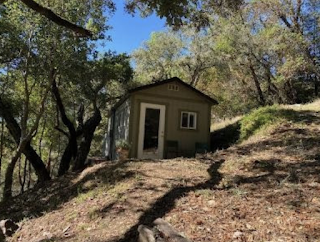
 I was recently scrolling through Shedworking (https://www.shedworking.co.uk/), a UK* site for hopes and dreams about writing houses, when I saw this two-parter about the novelist, short-story writer, and critic George Saunders (Lincoln in the Bardo is his award-winning novel).


Here, from Shedworking, is a picture of his writing house in California. 

(Insert pause here while you sigh with delight.)

And here, from the New York Times* via Shedworking, is a bit about his writing practice:

"Saunders writes in a shed across the driveway from his house, where we sat for a couple hours one morning while his two yellow labs nosed around outside the door. There’s the desk and a sofa and a table stacked with books that he has been researching for his next project."

And this from The Guardian: 

"His first newsletter includes a photograph of his solitary writing shed in the woods behind the house in Corralitos. His wife, Paula, bought it for him a few years ago, and it’s a writer’s dream. No fences or distant rooftops. Just the shed surrounded by trees and the shadows of trees. Writers’ rooms are usually reclusive. But Saunders is using his to host a writing community. Why does he care? “I suppose one of the things that a person worries about along the way is, ‘Does this really matter?’”

  “To go up in that shed every day was so helpful.” It was, he says, a way of saying: “‘I can’t control the world.’"

And finally, from his new substack at https://georgesaunders.substack.com/p/welcome-to-story-club, which sounds very much worth the $6 a month:  

"I’d come flying/stumbling down at the end of the day from a little writing shed I have up on the hillside in Corralitos, California, feeling, not that I’d “taken a break from” the current difficulties, but that I’d, well, girded up my loins for a deeper, less fearful engagement with the world."  

I am tempted to join the Story Club substack, not only for the pleasure of learning about writing short stories from a contemporary master at the top of his game but also in hopes that we will see interiors of the writing house.

Digression 1:  The Brits take their garden sheds/writing houses very seriously and even have an award for them.

Digression 2: From the New York Times piece, I learned that Saunders has the same guilty pleasure that I do--reading Vanity Fair on a plane. Famous genius writers and obscure bloggers--they're so alike!


Sunday, October 31, 2021

RBOC and some writing inspiration

  •  First, some writing inspiration from Paul McCartney in The New Yorker: "As McCartney recalls, “George would say, ‘Be here at ten, tune up, have a cup of tea.’ At ten-thirty you’d start.” Two songs were recorded by lunch, and often two more afterward. “Once you get into that little routine, it’s hard, but then you enjoy it. It’s a very good way to work. Because suddenly at the end of every day you’ve got four songs.” This puts Sir Paul in the "write every day" camp, and I am here for it. At the end of the day you've got four songs; at the end of the pomodoro, you've at least got more words than you did at the beginning.
  • More writing inspiration, but very vague, I'm afraid: a writer recently posted that he gets up really early to write not despite his being too tired but BECAUSE of it. The fatigue, etc. helps him to stop dancing around and actually get down to writing, because it turns off his inner editor. I saw this and shouted "this is me!" to the cats, except that for me 9 p.m. is the witching hour when the inhibitions put out a "gone to lunch" sign and I can settle into writing. I am still doggedly trying to write in the morning because at 9 p.m. on a teaching day, I am really too tired for any work, but morning writing is never going to be the same as those quiet evening hours.
  • Seeing pictures of modern writing houses, I'm struck by how they seem to come in two styles: stuffed to the gills with mementos, children's pictures, artwork, and various cozy knicknacks; and bare in a pure minimalist style, with just fancy chairs, a laptop, a couple of artbooks, and some inspirational "live laugh love" thingy on the wall, with nary a functional file cabinet in sight. The point is that they have a definite aesthetic. Mine does not have an aesthetic, unless "office for reading and writing" is an aesthetic. To my mind it's the most beautiful (because it's roomy and mine and I love it), but I was ridiculously fretting about its not making A Coherent Aesthetic Statement and that I was somehow shortchanging it because I wasn't making it beautiful enough. Spouse wisely said "it's for your work, not theirs. Work is your aesthetic."
  • My double life of pretending regret about not going to conferences and that there is no COVID or that travel is not a challenge, like the rest of the academic conference world, is making me a bit irritable privately, though I'm still maintaining the public facade. 
  • Was Halloween always such a big deal? When I was a kid, we dressed up and went trick-or-treating on October 31, usually with our parents, but they didn't dress up and the houses were just regular houses, not decorated. Around here everything is Halloween for all of October, and a lot of people decorate and dress up. Was it always this way? Or do we just want more holidays now (not a bad thing)? 

Monday, April 19, 2021

NYTimes's Adam Grant on Languishing : When you've lost that (writing) feeling

 At first I didn't click on Adam Grant's "There's a Name for the Blah You're Feeling" because I thought it was my friendly companion "meh." But it really does have a name: Languishing.

Languishing is a sense of stagnation and emptiness. It feels as if you’re muddling through your days, looking at your life through a foggy windshield. And it might be the dominant emotion of 2021.


    Last summer, the journalist Daphne K. Lee tweeted about a Chinese expression that translates to “revenge bedtime procrastination.” She described it as staying up late at night to reclaim the freedom we’ve missed during the day. I’ve started to wonder if it’s not so much retaliation against a loss of control as an act of quiet defiance against languishing.


That means we need to set boundaries. Years ago, a Fortune 500 software company in India tested a simple policy: no interruptions Tuesday, Thursday and Friday before noon. When engineers managed the boundary themselves, 47 percent had above-average productivity. But when the company set quiet time as official policy, 65 percent achieved above-average productivity. Getting more done wasn’t just good for performance at work: We now know that the most important factor in daily joy and motivation is a sense of progress.

I don’t think there’s anything magical about Tuesday, Thursday and Friday before noon. The lesson of this simple idea is to treat uninterrupted blocks of time as treasures to guard. It clears out constant distractions and gives us the freedom to focus. We can find solace in experiences that capture our full attention.

This makes a great deal of sense, especially with a phenomenon that I've been thinking of as "running out of steam." Say you're excited about Project A, you do the homework on Project A, you set aside the time to work on Project A, and then  . . . nothing. 

It's not like usual writing procrastination and anxiety, which are still there for some things. It's more like the excitement dissipating when you have to conjure up the energy to actually put those words down. The energy vanishes.

It's also important to note that not everyone in academia has the luxury of languishing--parents of little kids, overworked instructors, etc. etc. etc. Tanya Golash-Boza of GetaLifePhD wrote on Twitter had published "75 books and articles"* because she sleeps 8 hours a night, writes for 1-2 hours every workday, and doesn't "get in her own way." 

There was swift backlash, and she later revised it to acknowledge her academic privilege of a low courseload and good research funding--and attributed her success to not hanging around Twitter [except to promote her brand] and spending the time writing.

Her basic point, though, is the same as Grant's: set boundaries. Give yourself time to write, and then do it--i.e., get out of your own way. 

In other words, don't languish. Get past the "meh."


 *Edited to add: I just realized that this reminded me of Bachman in Silicon Valley, when he lumps his  his money with Bighead's and announces that their company has $20,013,000, never specifying that the the $20 million belongs to Bighead and the 13K to guess who.


Tuesday, July 14, 2020

Invictus, I guess, and maybe some writing inspiration

Are you finding you're having good weeks and bad weeks in coping mentally with the way we live now?

This isn't meant to be a complaint. I have nothing to complain about--no child care to worry about, enough space & time to walk, the strength to get my own groceries (23rd Psalm motto: my mask and my gloves, they comfort me), a car, etc.

But at the end of the day, I'm hard pressed to say what I did, especially in terms of intellectual work.
  • Some days it's a few hours of meetings: some colleagues, when I say "we've been on Zoom for 90 minutes; it's time to wrap up" will say "just this one thing then." Sometimes I simply say "gotta go" and bail anyway. But that still leaves a lot of time to read & write, so why don't I?
  • Some days--well one day every 2-3 weeks--it's grocery day, so I mask up (I only have one mask, having lost the other) and drive around and get what we need. I come home, do the Silkwood shower, and get to work, or try to. 
  • Some days it's sit and obsess about the fall classes, which are not totally online, even though I'm trying not to. 
  • Some days, once I've gone for a long walk, which I try to do every day, I just want to admire the trees. 
  • If I do an article or manuscript review, well, then--I'm done, right?
  • There's always cooking and baking and some laundry, but I look forward to those tasks, because I get to watch old comforting TV then and not otherwise, a self-imposed rule. Spouse has always done the laundry, but he has backed off after seeing from my woebegone face that I couldn't spend 20 minutes watching The Crown or The Office if I weren't folding clothes.
Last week was the week of magical thinking about writing.
  • If I sit down to write before breakfast, I will write.
  • If I walk first, before breakfast, I will write.
  • If I walk, then shower, then eat breakfast, I will write.
  • If I change it up and eat, then walk, then shower, I will write.
  • If I start at 8:30, I will get in the habit of it and write.
 You get the picture. I figured that there was a magical sequence to daily activities and if I could just get the sequence right, the writing would follow. It was a helpless feeling: oh, no, I've got the sequence wrong. Too bad about today!

Then on Monday something snapped: it's just writing. There is no magic sequence. It's just writing. If you break out in a fidgety cold sweat when you sit down to write, well, pick up a book and start reading, and you'll want to write fast enough.

Someone Being Wrong on the Internet is nothing to Someone Being Incomplete in a Book for getting your writing juices going.


I control the process. Me, not magic sequences. It may be lousy, but what comes out is still writing.

Henley's words*:

I am the master of my fate:
I am the captain of my soul.


*Yes, I know: imperialism, yadda yadda, but it helped in the moment. 


Friday, August 02, 2019

Productivity is overrated? NOW you tell me.

I spent the last two weeks doing eldercare, cleaning and cooking and chatting and problem-solving and strategizing and being on the phone with banks, cable services, etc.,  trying to gain access to straighten out financial messes.  (PSA: for the love of God, please grant someone Power of Attorney so that they can legally act for you before you develop dementia.) When people inquired brightly "How are you enjoying your vacation?" I had to bite my lip.

In the meantime, the work I had no time to do rolled in through my email as usual, despite my autoreply. 750words gathered dust and spiderwebs because I had no words to give it.

But wait! The productivity writer Theresa MacPhail now says "OK, I admit it: Productivity is Overrated."

In questioning "academe’s 'I’m so busy' Olympics" MacPhail cites Melissa Gregg's Counterproductive:
"Paradoxically," Gregg writes, "the capabilities of productivity software create expectations of always more activity." And she should know. She’s surrounded by engineers and software developers trying to maximize their time. As Gregg is quick to point out, however, all of the time saved from efficiency and productivity apps only increases the amount of free time that one is then expected to funnel back into — you guessed it — more work.
 Isn't that the old joke about academe? You work harder and for that your reward is . . . more work?

Isn't it sick that I want to know exactly what "productivity apps" Gregg is talking about?

And isn't it ironic that the sidebar ad is  The Chronicle Productivity Guide to Writing & Publishing?

Maybe this is a welcome and needed corrective to the culture of busyness, like Slow Writing a few years back. Or maybe it's just the usual pendulum swing, as when HGTV derides as "dated" all the trends it spent the 2000s shilling for as "classic," or how 1970s-style unpadded & un-underwired bras are now making a return as the "bralet."

At this point, I'm going with "needed corrective" because my productivity meter has run out, and I need a break. It's nice to have the backing of experts on this.

Sunday, May 05, 2019

Writing inspiration: Robert Caro, time, and age

I know I've written about Robert Caro before, but I'm about to dive into On Working. Here's a roundup of recent articles by and about him:

https://www.nytimes.com/interactive/2019/04/01/magazine/robert-caro-working-memoir.html

https://www.newyorker.com/magazine/2019/01/28/the-secrets-of-lyndon-johnsons-archives 

https://www.npr.org/2019/04/15/713413916/biographer-robert-caro-on-fame-power-and-working-to-uncover-the-truth

First, a tidbit: Caro writes in longhand and then on a typewriter:
It's because of something that was said to me at Princeton by a professor, a very courtly gentleman, Southern gentleman, who was my creative writing teacher. Every two weeks we'd hand in a short story. I was in his course for two years. For two years he gave me high marks, but I always did these short stories at the last minute. ... I would always start at the last minute and just type, because I could write very fast.

At our last session, he hands back my short story ... and he compliments me, and as I'm getting up to go he says, "But you know, Mr. Caro, you will never achieve what you want to achieve unless you stop thinking with your fingers." ...

But when I quit to do a book, and I began to realize how complex the story of Robert Moses was; I said I must make myself think things all the way through, and the slowest way of committing your thoughts to paper is by writing in hand. So I write three or four or more — sometimes I write a lot of drafts in hand. Then I go to my typewriter and that's how I write.
 Now the age part:

As with George R. R. Martin, at some point in every interview, the interviewer comes up with something like "Mr. Caro, you're 83 and still projecting your next book on Johnson. Don't you think you ought to get a move on?" The one from the NYT is this:

What does it mean to know that there is a group of people out there having the somewhat morbid concern that you might not finish your book before you die? It’s hard to avoid that. Every time someone does an article on me it’s there.

Caro's response is basically this: "You've got me there, but really, that's your problem."  In other word, the process of writing takes what it takes. He's got 99 worries but mortality isn't one.

It's not so much that he's advocating slow writing for its own sake; instead, he wants to get it done the way he wants to get it done.

As I get back to writing after a month of various elder care crises and chaos, I find this comforting.


Sunday, March 24, 2019

Time management and the confetti bomb

Gwinne and Dame Eleanor have good posts up about time management and schedules and also links to people who write about time management and schedules. ("fabulous SHU" and "GetaLifePhD" and "Raul Pacheco-Vega" are three of them.)

Such charts! Such beautiful, colorful charts! I hunger for their time charts.

But then reality sinks in. As xykademiqz described so eloquently (and I posted, too), charts are not for the likes of us INTP types. And even if the MBTI is invalid, I'm claiming that it is because it fits.

Figure 1. Leuchtteurm1917 or . . .
For now, I'm sticking with the ex post facto method: the black notebook, in which I record what I'm actually doing, with a to-do list in the right margin, rather than how I think my day might unfold. I also keep the Excel spreadsheet for writing and noting events.

It's gotten so bad (or good) that if I do anything mildly work-related--write, read, grade papers, answer emails (especially answer emails)--I grab frantically for the black notebook to write down the time.

If I work, it's in there. If I waste time, it's in there. At least I know what I was supposed to be doing, because of the to-do list.
Figure 2.. . . Moleskine? Name your poison.


This is where the confetti bomb comes in. Suppose you're sitting in your office, as one does, grading papers, as one does, and keeping to your color-coded grading block.

Then, if you're a person in the world, and especially an administrative person in the world, someone walks in and says, in effect, "Congratulations! Here's a juicy, complex problem that it will take many phone calls, meetings, and a lot of thought to solve. Oh, and it needs a solution now."

That someone heaves a confetti bomb, which then detonates all over your desk.

Now, you could say this: "Now is my SACRED WRITING TIME or SACRED GRADING TIME or MY ORANGE BLOCK! Can't you see that it is my orange block and not a confetti block? Go away immediately. My chart says you can't be here."

Or you could do what most of us do.

Get to work cleaning up the confetti bomb, and write it in your notebook so you'll know why your best-laid plans gang aft agley. 

Friday, November 16, 2018

Writing inspiration from Jonathan Franzen

Figure 1. Jonathan Franzen on Lithub.
It's time to check in with our bird-lovin', Oprah-scornin', Edith Wharton-hatin' friend Jonathan Franzen again.

Franzen published 10 rules for writing on Lithub, and Twitter has been having, um, a little fun with them.

The rules themselves are not that bad. They're pretty sententious, like Franzen's fiction, and pretty humorless (ditto).  Here's one of them:

"It’s doubtful that anyone with an Internet connection at his workplace is writing good fiction."

A couple of thoughts: 

1. "his workplace." Should we let it go? 
2. So Joyce Carol Oates isn't writing good fiction? 

I have a feeling that this is actually a burn against unseen adversaries, designed to make them feel, as the young folk say on Twitter, "seen." 

At least it's a list and not an endless paragraph in 6 volumes, and at least he isn't telling you to get rid of your dog if you want to be a great writer.  

The Guardian collected the responses to his list, and some of them are pretty funny. Not to be outdone, Lithub published a collection right after they published the list from Our Boy.

But how different are these, really, from the lists that we all make from time to time or that wend their way around Twitter? 

Does he deserve this level of mockery, or is it because he takes himself so seriously?

I'm not holding any brief for Jonathan Franzen. (I have read Jonathan Franzen.) But we put up with Captain Obvious statements all the time, including a fair number in obscurantist language from literary theorists, and all we say is, "Yes, emperor, those clothes are stunning." 

My guess is that hating Jonathan Franzen is like a meme, and maybe like some others, he'd rather be hated and talked about if he has books (or a political persuasion) to sell than to be ignored. 

And he's not on Twitter. He's . . . writing. So even if his advice isn't inspiring, I stick by my guns that his example is.


Thursday, September 20, 2018

Catching up on the week and some writing inspiration

I'm getting ready for something for which have to get the writing done--have to. I've been paralyzed with anxiety about writing. What worked the other day?

Sit down and time myself like Anthony Trollope. He used to write 250 words every 15 minutes for 3 hours a day, by the clock, before he went to work. Every day. Now, you can say what you want about the quality of Trollope's novels (most of them are pretty good), but you can never deny that they are done. 

So, with the help of this https://www.brainpickings.org/2012/11/20/daily-routines-writers/:

  1. I wrote down the time in my trusty black notebook, giving myself 25 minutes (a Pomodoro) to write 200 words in 750words.com. Every time I got up from the desk or looked at email, I had to write it down. Pomodoro after pomodoro until the afternoon when I went for a walk. It worked! 
  2. I promised myself when I finished 2000 words for the day I could have chocolate. I didn't get to 2000, and I didn't get chocolate, but I got to 1300, which is more than I would have otherwise. 
  3. Writing before school isn't an option because I get up early and have a long commute, but if I leave at 2:30 the day is still relatively young and I can get some writing done after dinner sometimes. 
Other positive items:

1. Three weeks ago I gave up FB and advice columns, cold turkey, and I don't miss them. FB was making me miserable because everyone was finishing book proposals, book chapters, etc. and I was not. Deciding there was no need to torment myself, I hung a "gone fishin'" sign on the site and haven't been back--ditto for the advice columns.

2. One of my colleagues who never attends any kind of department meeting and is minimally on campus saw me the other day and said, "Where have you been? I haven't seen you around." I said, "right there in the office and around," and I did not strangle her, so victory is mine.


3. I'm really enjoying my classes. 

Saturday, July 14, 2018

Writing inspiration: last archive day

Waking up at 4:30 a.m. when the local Starbucks (closest food) does not open until 7:30 a.m. isn't ideal, but it did give me some time to reflect on a few things after seeing the work of my betters.
  • These people took care of business. When I was sitting there reading folders full business letters and contracts, I had to stop and think that this was just one side of what Author A (let's call his/her/gender neutral them "A") was doing every day. Let's not forget the usual things: building or making or buying houses, gardens, boats; getting the plumbing fixed, etc.
  • And they took care of friendship. Reading another whole set of letters, I realized that they were not about anything consequential to researchers because that's of course not the point, is it?  But the letters were about things that were absolutely, vitally important to A and their correspondents' lives: family doings, asking about mutual friends, civic engagement, shared tasks, gifts, ill health, visits and travel, and oh, incidentally, work. It's easy to miss the forest for the trees in this and try to cherry-pick one reference to what we see as A's "real" work, when actually, their life can't be separated out any more than ours can today. When you read them as a whole, you see a fabric of human connection being woven.
  • And they kept things and kept track of things. Notebooks, story plans, drafts, scraps of paper, newspaper clippings, diaries. It's heartening to see that A sometimes starts a notebook and then leaves the rest blank, since I'm guilty of this, too. But did you ever stop to wonder what would happen if someone needed to research you and your work? (Not likely, but still.) What would they find? I'm not the first to comment that the electronic age has changed what we keep and discard, and recycling has probably taken the rest. Would any of us even have an archive?
  • And they wrote. Every day, sick or well, rain or shine. As you see the authors get older or, in the case of younger authors, become ill, it seems--well, gallant is the only word for it. In the midst of all of the above (and all that's not included there: eating, sleeping, exercise, excursions, being with friends, reading, domestic or romantic crises, tragic losses) they put words on paper, not on Twitter and FB (I'm sniping at myself, not at anyone out there). Sometimes they didn't succeed in finishing something but kept the scraps anyway. It's a good reminder that even the things that didn't work out were part of the process for something else. 
Anyway, this is a "note to self": do better, and remember that if you don't keep at it, it won't get done. 

Thursday, May 31, 2018

Writing inspiration: overcoming burnout and the Orson Welles syndrome

Figure 1. Orson Welles, wunderkind.
At a conference recently, I talked to a few people about their careers and about the wall of writing burnout I hit recently, asking them if they had experienced the same.

How bad was the burnout? Think of trying to get a balky toddler to eat a lima bean-spinach-kale casserole: that's how I was approaching writing. Those lima beans weren't going to taste any better cold--that is, after the deadline--but my brain toddler, unlike any real toddler, has to eat them anyway and get that writing done.

The people I talked to said that they were looking about three years ahead instead of to the next deadline. One was looking to get a book finished in that time. Ze had hoped to be finished by now, but life happened. A second, one of my collaborators on the big project, is shaping zir career around that for the next 5 years. A third is looking at gradually tapering off scholarship in preparation for a phased retirement. When I protested "but you're so productive! Don't you want to write another book?" ze said that there was no economic incentive and that ze would rather spend the time rock climbing.

Although they have different perspectives, they all had the same advice for me: be selective, because if you agree to do too much, you'll always be behind. Write about what you really want to write about. And take a break once in a while. If this sounds familiar, like advice that you and I and everyone else has given on their blogs, it is, yet it had some more force coming from people I'd known a long time.

It's probably unfair, but I'm thinking of Orson Welles, the genius writer-director-producer-actor who made radio history with his "War of the Worlds" broadcast in 1938 (inventing fake news?) and cinema history with Citizen Kane. He followed that, sometimes acting instead of directing, with The Magnificent Ambersons, The Lady from Shanghai, The Stranger (which he thought was formulaic but that I liked), Touch of Evil, and a host of other movies, some of which, like The Other Side of the Wind, he worked on for years.

The knock on Welles, dating from The Magnificent Ambersons, was that he didn't want to finish things, which apparently wasn't true. He did spend most of his career after Hollywood trying to get financing to fund the projects that he loved, like the Don Quixote film that remained unfinished at his death.

But what many may remember him for is the talk show circuit and his magic tricks, or the Paul Masson commercials where he solemnly intones "We will sell no wine before its time." He tried to do too much, often for financial reasons, and ended up not doing what he wanted to do (Orson Welles syndrome, TM Undine).

Now, Welles was a genius and could keep more balls in the air than most of us, yet you wonder what he might have done if he hadn't had to squander time and attention in making money with commercials, voice-over work, meetings with investors, etc. Would he have made more and greater movies? Would he have been able to make movies without resorting to that awful dubbing that makes some of those late movies (for me) unwatchable?

The thing is, most academics actually have that opportunity if we have jobs--to focus our attention and to choose projects--without having to take on too many side projects to keep the projects we love going. My conclusion is to try to take my colleagues' advice and assess what I really want to do next.

Friday, May 11, 2018

Writing Inspiration: Squad Goals


All across the country, academics are saying "there, that's done!," turning in grades, looking up, stretching their arms, and saying "Writing? Bring it on!"

Or some version of that. Because we're an academic squad, yes we are, and we're ready to get moving.

I don't want to make a list here of all that I want to get accomplished because (a) I don't want to bore you all and (b) as xykademiqz so eloquently pointed out a few weeks ago, a list like this would make me run screaming in the other direction.

So what are some more general goals?
  •  Limit your email time. I know, I know--this is advice we get and give anyway. But in the summer, unless you're teaching or have an admin job, you really can do this. As much as you can, ignore it.
  • Think about this: who's paying you this summer? If you're on a 9-month contract, YOU are paying you this summer, in the form of savings or however you've managed to figure out finances so you can live.  You are paying yourself to do the writing, and you are your own boss. So don't forget: all those lofty statements about "we can work on this departmental initiative over the summer" or emails that might as well have the header "let's discuss this contentious issue in long, irate, time-consuming threads" are asking you to stop working for pay (for yourself) and asking you to work for free. 
  • Write when you feel like it as well as when you're supposed to.  Boice, Silva, et al. make a big point of telling you to get writing at a regular time and then stop. But what if your ideas are still flowing at night even after you know you have to go to bed? Take out that notebook and do some writing so you won't forget it tomorrow. I read one time that George Sand, after a full day of strolling around Paris in pantaloons, negotiating contracts with her publishers, attending literary parties, and spending some time with her current lover, used to leave poor Chopin or whoever sleeping in her bed while she put on a dressing gown, went to her writing table, and wrote for a while. Let George Sand be your inspiration. 
  • Identify your rewards. Too much carrot-and-stick planning makes writing feel more onerous, but surely there's something you can promise yourself if you get done with what you'd like to do. Writing the word count down is a small reward, but maybe something like reorganizing books that desperately need it (an activity that's totally a procrastination strategy if you don't watch out) would be a good one. 
What would you add?

Sunday, March 11, 2018

Writing inspiration: Wordsworth, academic writing, and learning lessons over time.

The things that you learn about writing and about yourself accrue over time, don't they?

Figure 1. The Abbey he's actually not at but a few miles above.
Remember Wordsworth's "Lines, Composed a Few Miles above Tintern Abbey"?

The narrator thinks back to his youth:
when first I came among these hills; when like a roe / I bounded o'er the mountains, by the sides / Of the deep rivers, and the lonely streams,  /Wherever nature led
Did anyone else used to stay up all night and write a paper due the next day as an undergrad? It was sometimes good, sometimes bad (no revision!), but hey, it was done.

And now we're more like this:

hearing oftentimes 
The still sad music of humanity, 
Nor harsh nor grating, though of ample power 
To chasten and subdue.—And I have felt 
A presence that disturbs me with the joy 
Of elevated thoughts; a sense sublime 
Of something far more deeply interfused,

On one hand, that's a bit too elevated a sentiment for academic writing, but what we're doing is "interfusing" all that we've done into a meaningful piece of writing, even if it isn't "sublime."
I'm not doing justice to this poem at all, but it made me think of some recent things I've (re)learned:
  • It is what it is, or it takes what it takes. If it takes you 25 hours over several days to write a five-page paper about something that you already know well, with a ratio of about 4 hours of thinking and reading to 1 hour of writing, well, that's what it takes. Don't beat yourself up about it (says the person who has been doing just that). Try to make deadlines, but do your best even if you can't.  It's a process.
  • Speaking of process, when you're recollecting in tranquillity, like Wordsworth, you come to know your own processes well. That anxious bout of administrative editing when you should be writing? It's displacement writing, dealing with a lesser anxiety to avoid confronting the greater anxiety of the academic writing you have to do. The writing is working in the background, and it will emerge in good time when you do write. Bonus: the administrative task is that much closer to being done.
  • Don't follow literally the advice all over Twitter to "write drunk, edit sober." How do people do this if they're literally drinking? Maybe it works for them. What I took away from it, though, is to loosen up and spill everything out in paragraph form, if possible, and in list form, if not, even if it's too colloquial or too pompous or otherwise not a thing that I want in the paper. (I know that this is perennial advice, via Annie Lamott's "sh*tty first draft," but it's still important.)
  • Edit and revise and edit some more.  That bounding roe of an undergrad Undine would never have believed it, but--surprise!--it's as much the editing that tells you what you think as it is the writing. Again, know your processes: I have to see it on paper at certain stages, the header should have some kind of an autotext time stamp so that I know which version it is, and it helps if I have a red pencil to mark a big slash across pages after I've made the edits.
  • The more work you do, the more you know. The reading I've done to develop the three pieces of writing over the past six months (you know, the ones you've heard me complaining about) is actually paying off now in ways I couldn't have anticipated. 
  • Recognize what's not working.  Sometimes, if you're stuck on a piece of writing, there's a piece in there that doesn't belong, no matter how insightful it is or how fond you are of it. You can spend a lot of time trying to shoehorn it in, but sometimes you have to cut your losses and all those hard-won words. Mark Twain said that you should "kill your darlings" (also adverbs), but good news: with writing, you can put them in another file and save them for another day. If they're good, they'll survive.
  •  Delete those annoying emails. Tired of sanctimony and virtue-signalling and lengthy email lectures on Correct Principles when you already hold those principles? If there's no action required, delete them. Or put them in a folder called "Colleague Bloviations." It'll make you feel better and help your sense of focus. 
  • Let your writing helpers help you. Writing or accountability groups. 750words, Strict Pomodoro, Excel spreadsheets, etc. And for a bonus: get a new black notebook, since the old one is almost full.

Saturday, February 10, 2018

Me and my (shadow) notebook

We're getting good at keeping track of time, my little black notebook and I. 
  • Yes, it took me 7 hours to do that administrative task. It takes what it takes, but the thing is, I can't feel despairing because I wasted the day. It's not wasted. It has to be done. My notebook tells me how I spent that day when I'm beating myself up mentally about not writing more.
  • Receiving a long, detailed, multi-part email about non-urgent minutiae? How long will it take to read and respond? My notebook tells me. It's a number, that, anonymized, averages out to  "too long." Bottom of the reply list for it.
  • I send an email that doesn't receive a response but receive more non-urgent minutia-driven emails. Do I hasten to reply? I see from my notebook that this was discussed already with the person sending the email. I let the email sit for a while.
  • Meeting that's supposed to take two hours and we're only 2/3 of the way through the agenda? Unless the president or provost has convened it, I'm leaving at the end of two hours. This is the 70% rule that xykademiqz and gwinne have talked about.
  • Document, document, document those progressive emails.
    • X writes to say "I need you to break this rule for me" sent to someone not me. I reply to the person who forwarded it saying when X contacts me, I'll respond.
    • X writes to someone not me to say, "hey, could you get on this right now? Time's a-wastin' here!" Same answer. When X contacts me, though, I'm ready with a reply.
  •  The To Do List is in the little black notebook as well as in the spreadsheet. It's more satisfying to cross things off in pen than in a spreadsheet.
  • The spreadsheet only tells me when I didn't meet a goal (as in Paul Silva's How to Write a Lot) or how many words I wrote. The notebook tells me that I didn't get home until 9:15 p.m., which puts a little different spin on what looks like a wasted writing day though it was a useful campus one.
  • Because it also holds some drafts and bibliographies all in one place, I can tell when I've added something to a main document: the transferred material has a line through it.
  • In the notebook, I can trick myself into writing with pen and paper sometimes when the computer holds too many other distractions (grading, etc.), as Dame Eleanor talks about. 
  • And every day when writing happens, there's the number of words, circled, at the top of the page. Pasting or stamping gold stars to the page might be a step too far, but I don't need them anyway. The circled numbers are enough.